
Table of contents
2 – Are You Ready to Approach a Manufacturer?
3 – Where to Find Clothing Manufacturers
4 – Domestic vs Overseas Clothing Manufacturing
5 – How to Evaluate a Clothing Manufacturer
6 – Questions to Ask Before You Commit
7 – Red Flags to Watch For
8 – How Long Does It Take? A Realistic Timeline
9 – What Makes a Manufacturer Relationship Last?
10 – When It Makes Sense to Work Through a Production Partner
11 – FAQs
TL;DR — Finding a clothing manufacturer starts before you contact anyone: know your product, your volume, and your budget. Then it’s about where you look, how you vet, and which questions you ask. This guide covers the full path: manufacturer types, readiness, where to search, domestic vs overseas, evaluation, red flags, and realistic timelines. So you reach out prepared and shortlist the right partner.
Finding a clothing manufacturer is harder than it looks. The directories list thousands of factories. Most won’t take your order. Or shouldn’t.
The wrong partner costs you months and a damaged first collection. The right one makes quality, price, and timing workable from there.
So how do you find a workshop that fits your product, your volume, and your budget? Most brands spend three to six months on this search, much of it on dead-end emails. It doesn’t have to take that long. This guide covers how to find a clothing manufacturer the practical way. Let’s walk through it.
What Is a Clothing Manufacturer? (And the Types You’ll Meet)
A clothing manufacturer is a company that turns your design into finished garments. Some only sew. Some source everything. Some sell you a product that already exists. The word “manufacturer” covers all of them. Which is why your first job is knowing which type you actually need.
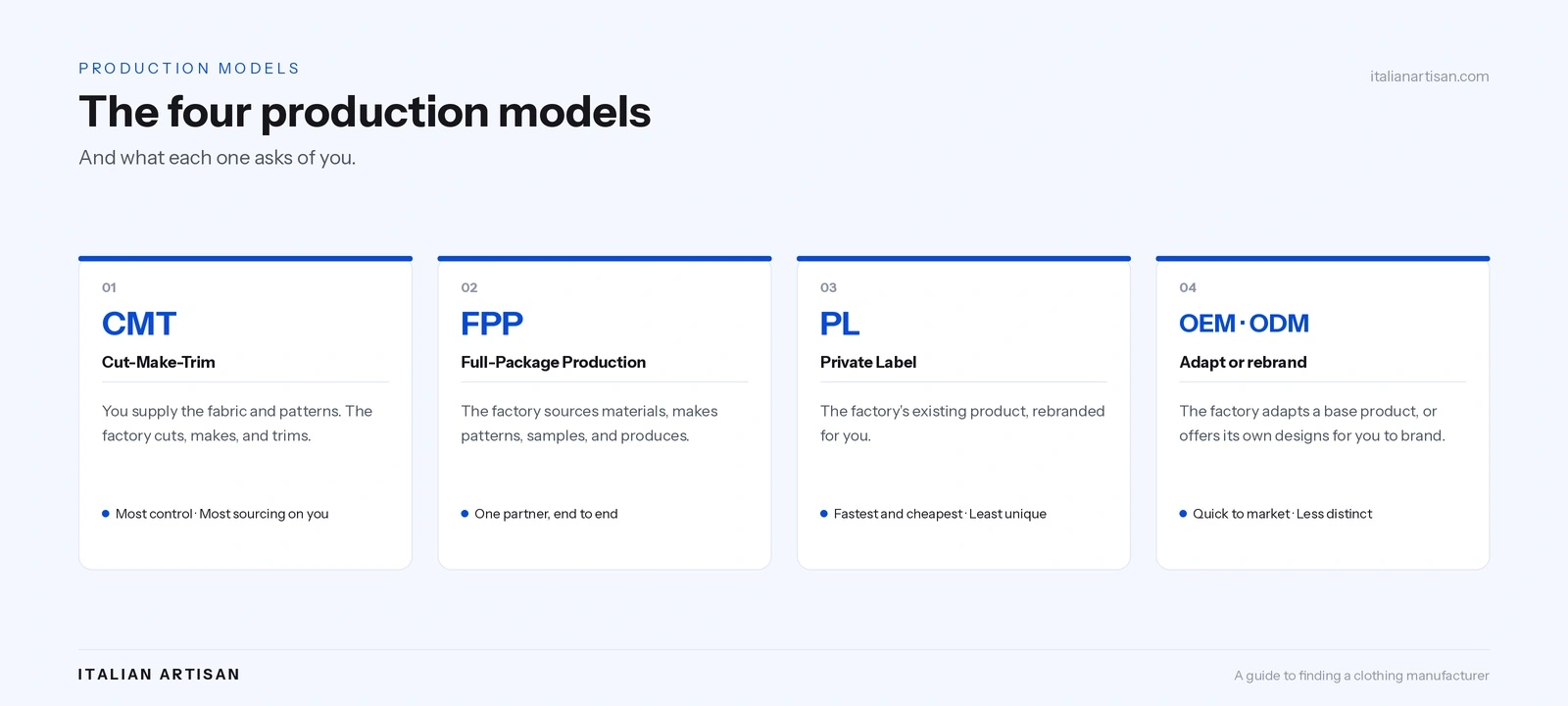
Four models cover most of the market:
- Cut-make-trim (CMT): You supply the fabric and patterns. The factory cuts, makes, and trims. Most control for you, and most of the sourcing work on you too.
- Full-package production (FPP): The factory sources fabric and trims, makes patterns, samples, and produces. One partner, end to end.
- Private label: The factory’s existing product, rebranded for you. Faster and cheaper to launch, but less unique.
- OEM and ODM: The factory adapts a base product to your spec (OEM), or offers its own designs for you to brand (ODM). Quick to market, with limits on how distinct the result feels.
Each type carries a different MOQ (minimum order quantity), a different price, and a different level of hand-holding. Get the model right and the rest of your search narrows fast. For a full breakdown, see our guide to the types of clothing manufacturers.
So before you look for a factory, decide which kind of relationship you’re actually looking for.
Are You Ready to Approach a Manufacturer?
Prepared brands get replies. Unprepared ones get ignored. Manufacturers field dozens of enquiries a week, and they can tell from one message whether you’re ready to produce or just exploring.
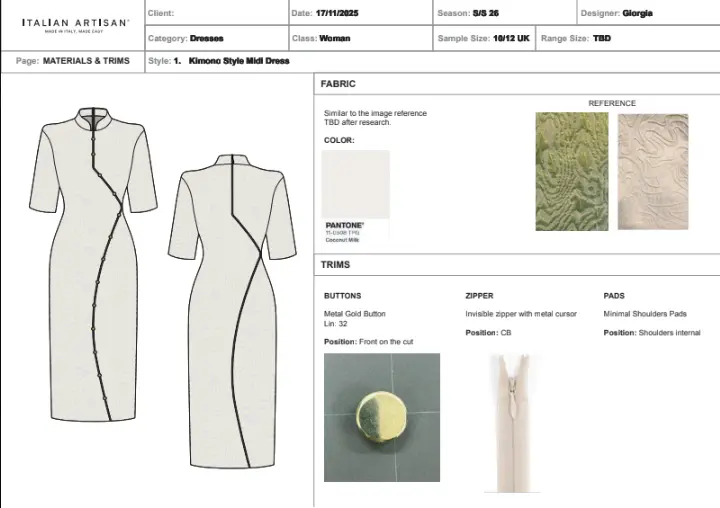
Before you reach out, have four things ready:
- A product brief or tech pack: The document that tells a factory what to make: fabrics, measurements, construction, trims. It helps, but it isn’t a must-have. If you don’t have one, don’t worry. Most manufacturers keep an in-house design team or trusted partners who can help build it. Here’s what to send to a clothing manufacturer.
- Your target MOQ: The number of units you can commit to. It decides which factories will even talk to you.
- Fabric direction: A sense of the material and weight you want. Many factories specialize by fabric, so this narrows the list.
- A realistic budget per unit: Know what you can spend before you ask for prices, not after.
Now, here’s the trap nobody warns you about: the design you think is finished.
More and more brands arrive with a concept built in Claude or ChatGPT. That’s a good thing. An AI mockup helps the factory and the designer understand the creative direction you’re after.
But a generated design is a starting point, not a production-ready spec.
In most cases, it still has to be redrawn. AI renders tend to ignore the technical limits of real materials. Proportions come out slightly off. Construction details don’t line up. Small imprecisions pile up into a sample that comes back wrong.
So bring your AI concept. Just don’t assume it’s done. The gap between “looks right on screen” and “can be sewn” is where most first samples go sideways. If you’re not there yet, start with our guide on how to get your clothing designs manufactured.
Where to Find Clothing Manufacturers
There’s no single best place to find clothing manufacturers. There’s a mix of channels, each with a tradeoff.
- Online directories: Broad and easy to search. But a listing isn’t a vetting. A factory being listed tells you nothing about whether it’s right for you.
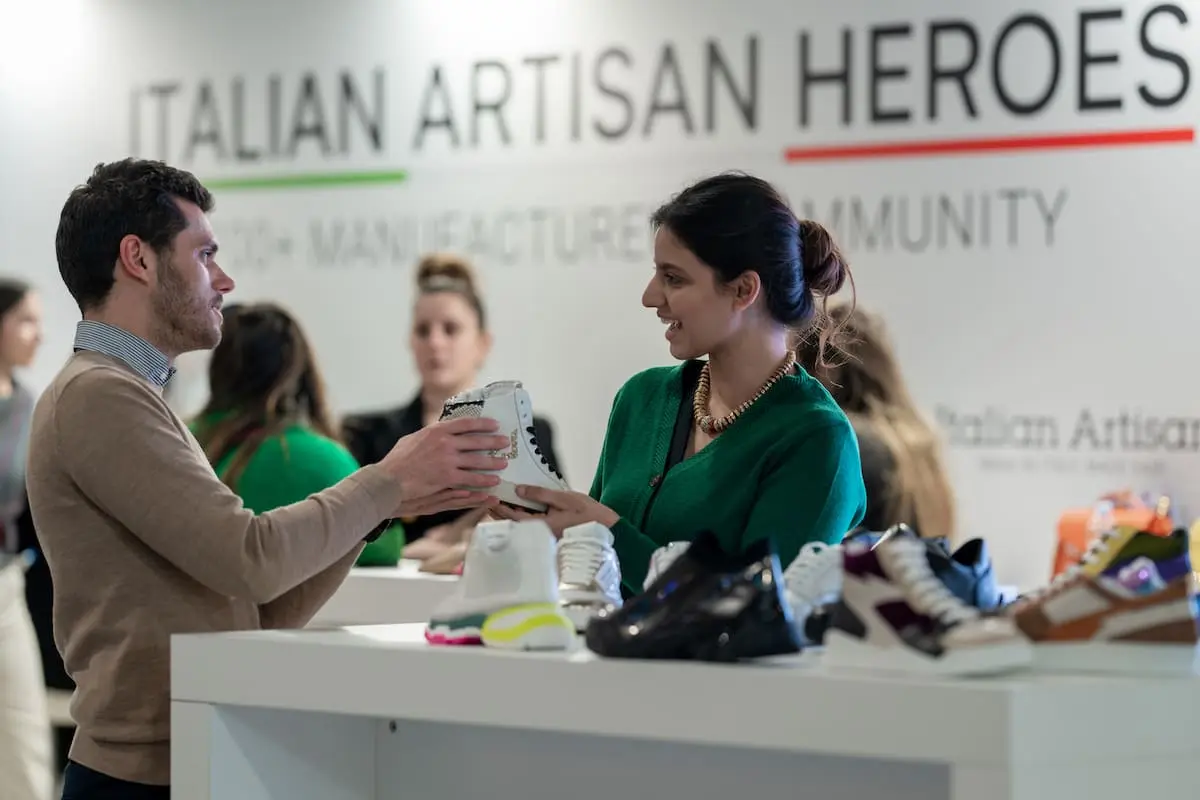
- Trade shows: Events like Première Vision, Milano Unica, and MAGIC let you see materials and meet factories face to face. Slower, but high signal.
- Referrals: Other founders are your best source. A factory that delivered for a brand like yours is worth ten cold leads.
- Niche Google searches: Search your product plus “manufacturer”. For example, “silk scarf manufacturer” or “organic cotton knitwear manufacturer.” Specific beats generic.
- Sourcing platforms and agencies: A managed partner does the matching and vetting for you. More on that near the end.
One honest warning about directories. The stated MOQ on a listing is often lower than the real one. The better question isn’t “what’s your minimum,” it’s “what’s the smallest order that holds stable quality and stable pricing.” Ask that early.
Domestic vs Overseas Clothing Manufacturing
The honest answer: overseas production tends to win on unit cost at high volume. Domestic and nearshore production tend to win on lead time, communication, quality oversight, and low-MOQ flexibility. Which matters more depends on your stage and your product.
Here’s how the tradeoffs line up:
| Factor | Overseas (volume hubs) | Domestic / nearshore |
|---|---|---|
| Unit cost at scale | Lower | Higher |
| MOQ flexibility | Often high minimums | Easier small batches |
| Lead time | Longer, plus freight | Shorter |
| Communication | Time zones, language gaps | Faster, clearer |
| Quality oversight | Harder to supervise | Easier to visit and check |
| Sampling and IP control | More distance | Closer control |
Overseas tends to make sense once you’re ready for real volume, and once you’re set up to manage the logistics that come with it: customs, freight, and shipments from the Far East that often move by full container. That’s a lot to take on for a first run.
One factor brands underrate is cash flow. Overseas suppliers usually ask for full payment upfront, so you pay for goods you might not receive for three to six months. Domestic and nearshore producers tend to be more flexible on terms.
We go deeper in domestic vs overseas clothing manufacturing.
How to Evaluate a Clothing Manufacturer
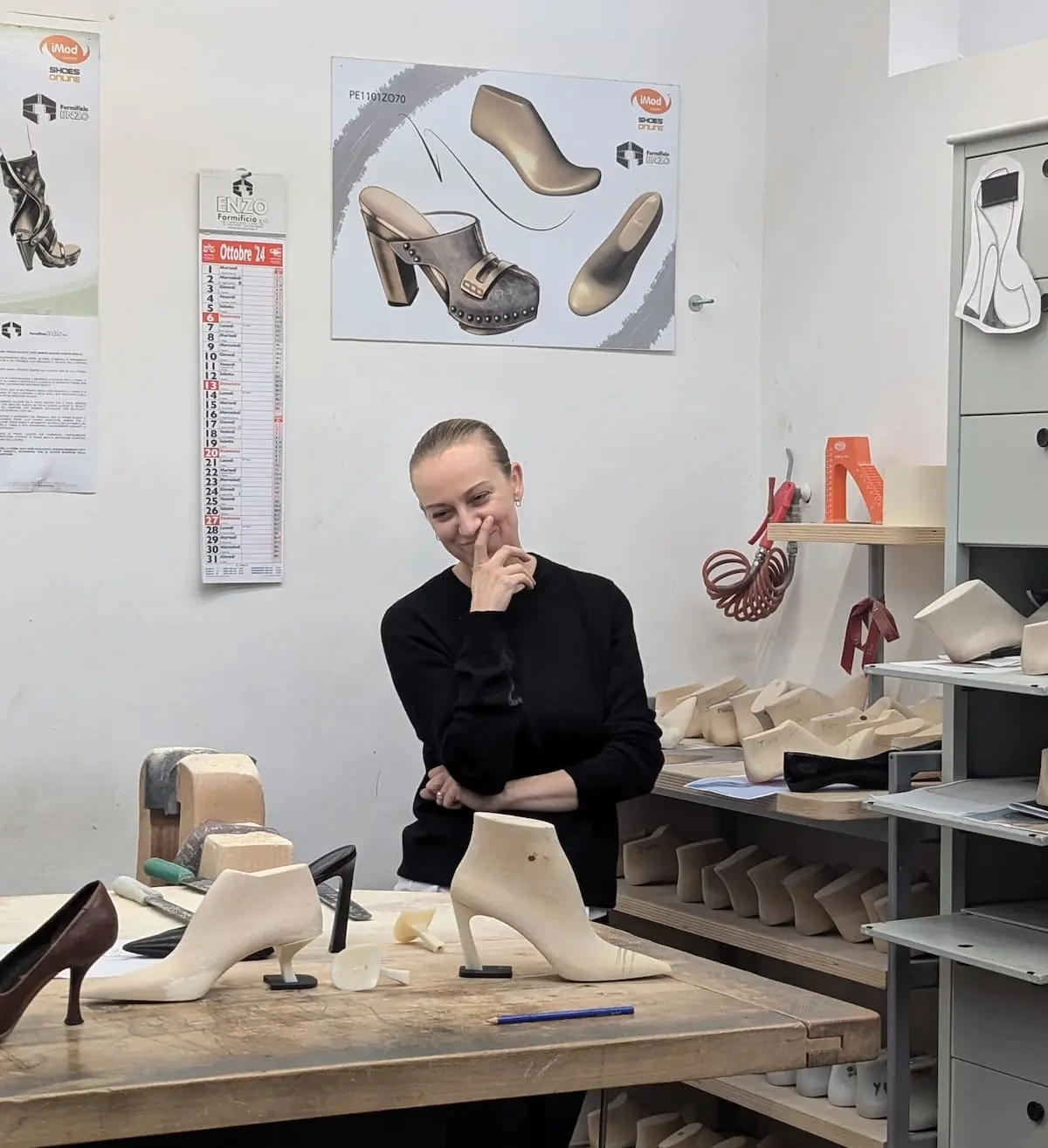
Evaluating a clothing manufacturer comes down to one question: can this workshop make your product, at your volume, to your standard. And will your order actually matter to them? Quality is rarely the issue. Fit is.
Two mistakes show up again and again.
The first is chasing the famous name. Let’s say you want to make 50 silk scarves. You find the workshop that produces for the big luxury houses, and you think: for my brand, only the best. The problem isn’t the quality. It’s the fit. A house that turns over tens of millions has high minimums, and your 50-piece order sits at the bottom of its priority list. You’re far better off with a workshop where your project has weight, and gets real attention.
The second is outgrowing your factory. A brand develops its first collection with a small family-run workshop. A great start. Then it scales, the collection grows, and the production cycles get too slow for the new volume. At that point the work has to move. There’s nothing wrong with starting small. Just plan for where you’re going.
So match the factory to your volume and your trajectory, not to its logo. Once the fit is right, vet in this order:
- Category fit: Ask for samples in your exact product type. If a factory can’t show relevant work, that’s your answer.
- MOQ fit: Confirm the minimum matches what you can commit to.
- A sample: Never commit to a production run you haven’t sampled. This one rule prevents most costly mistakes.
- References: Independent and startup brands tend to give the most honest feedback. Ask for a few.
- The human factor: This is a partner, not a vendor. You’ll work closely for months, so it has to click on a human level. Trust your read on the people, not only the spec sheet.
What does a realistic MOQ look like? As a rule, expect to start around 50 pieces per style. From there it depends on the product, and mostly on the fabric, since materials are sold in their own minimums. You can produce fewer. But very small runs get treated as samples, which means paying two to three times the per-piece price.
For the full method, see how to choose a clothing manufacturer and our step-by-step guide on how to vet a clothing manufacturer. If small runs are your priority, start with a low MOQ clothing manufacturer.
Questions to Ask Before You Commit
The right questions tell you in one conversation whether a manufacturer is a fit. Ask these before you send a deposit.
Start with the one most brands skip: who supplies the fabric?
Most workshops will do it either way. They can source the fabric, or you can. But they usually prefer to supply it themselves. They use a material they’ve run before, and they add a margin, generally 5 to 15%.
“Most workshops would rather supply the fabric themselves. They know the material, they’ve run it before, and there’s a small margin in it. When a brand brings its own fabric just to save money, the saving usually comes back somewhere else.”
Some brands insist on supplying their own fabric to cut costs. From what we see, that rarely wins. If the only reason is saving money, the factory tends to recover the lost margin elsewhere. On the hourly cost of the work. On extras like glue and cutting. On lines you can’t easily challenge.
There is a good reason to supply your own fabric. It’s product, not price. A factory will usually steer you toward suppliers it already knows. If you’ve done your own material research and want a specific cloth, supply it. If it’s your first collection and you haven’t done that research, trust the factory’s suppliers.
Then work through the rest:
- MOQ and price breaks: Ask for quotes at different quantities, say 100, 300, and 500 units. The per-unit price tells you how scale changes your costs.
- Sampling cost and rounds: How much is a sample, and how many revisions are included?
- Lead time: For sampling and for bulk, in writing.
- What they specialize in: A factory that claims it makes everything usually masters nothing. Specialists in your garment type deliver better results.
- References and current clients: Who have they produced for, and can you talk to them?
For the complete list, see our guide to the questions to ask a clothing manufacturer.
Red Flags to Watch For
The clearest red flag in a clothing manufacturer is how it communicates. Slow replies, thin answers, and a partner who promises everything and asks nothing are the signals that matter most. Trust them early, because they rarely improve later.
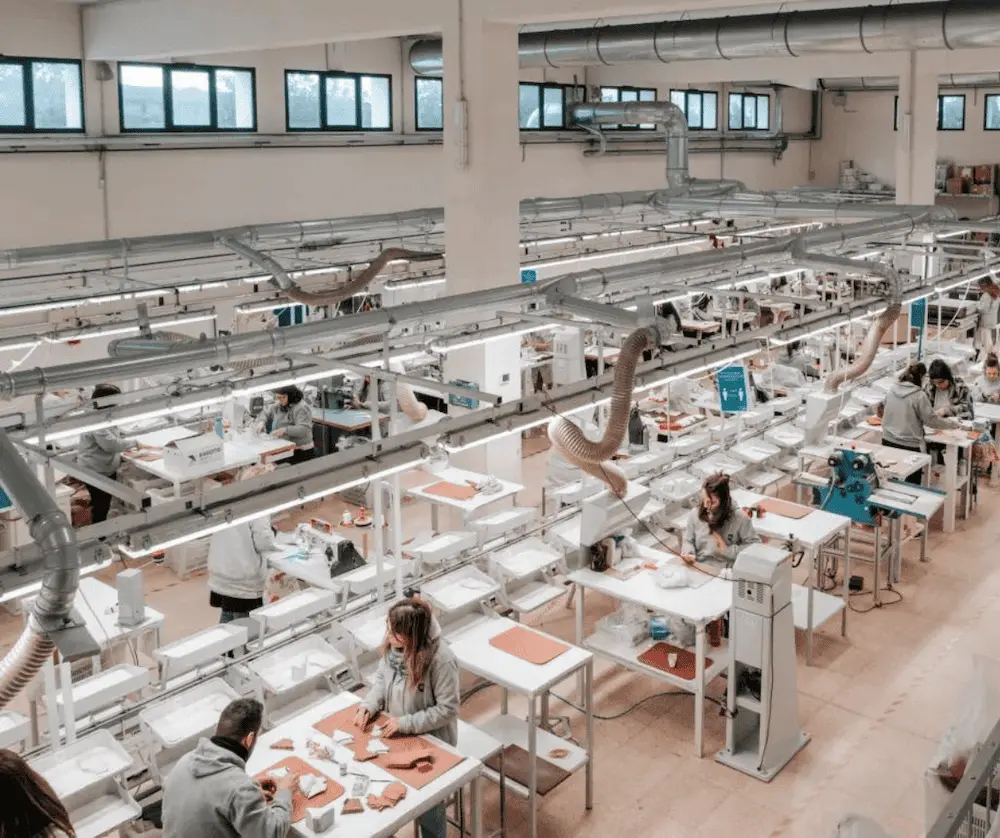
Watch for these signals:
- Slow or vague communication: Your first real signal. If replies are slow, answers are thin, or the back-and-forth drags from the very first email, that’s how it will run in production too.
- Overpromising: When everything sounds too good, ask questions. A factory that says yes to everything, promises bulk in a week, and never asks for detail usually isn’t a genius. It’s trying to win the order. The problems surface later, once you’ve committed.
- A disorganized floor: If you can visit, even once, take the chance. A visit shows whether they really produce in-house or subcontract the work, how they operate, and under what conditions. You’ll read the place in minutes, and that tells you more than any sales pitch.
See the full list in clothing manufacturer red flags.
Here’s what most guides miss: the red flags run both ways. A good workshop is reading you, too. Two things make an experienced maker walk away from a brand.
The first is stubbornness. Sometimes a brand designs something (often an AI concept) that can’t be built the way it’s drawn. The maker will offer the closest workable version. But if you won’t revise anything, the collaboration stalls before it starts.
“What makes a brand hard to work with isn’t a tight budget. It’s not listening when something can’t be made the way it’s drawn, and forgetting there are people behind the work. A word of thanks goes a long way.”
The second is how you treat the people making your product. For an artisan, recognition matters as much as the invoice. Be clear, be fair, and acknowledge good work. It changes how your project gets handled.
How Long Does It Take? A Realistic Timeline
From first contact to finished goods, a clothing production usually takes three to four months, sometimes more. Design, prototyping, sampling, fabric, and production each take a slice. And the biggest delays come from the brand, not the factory.
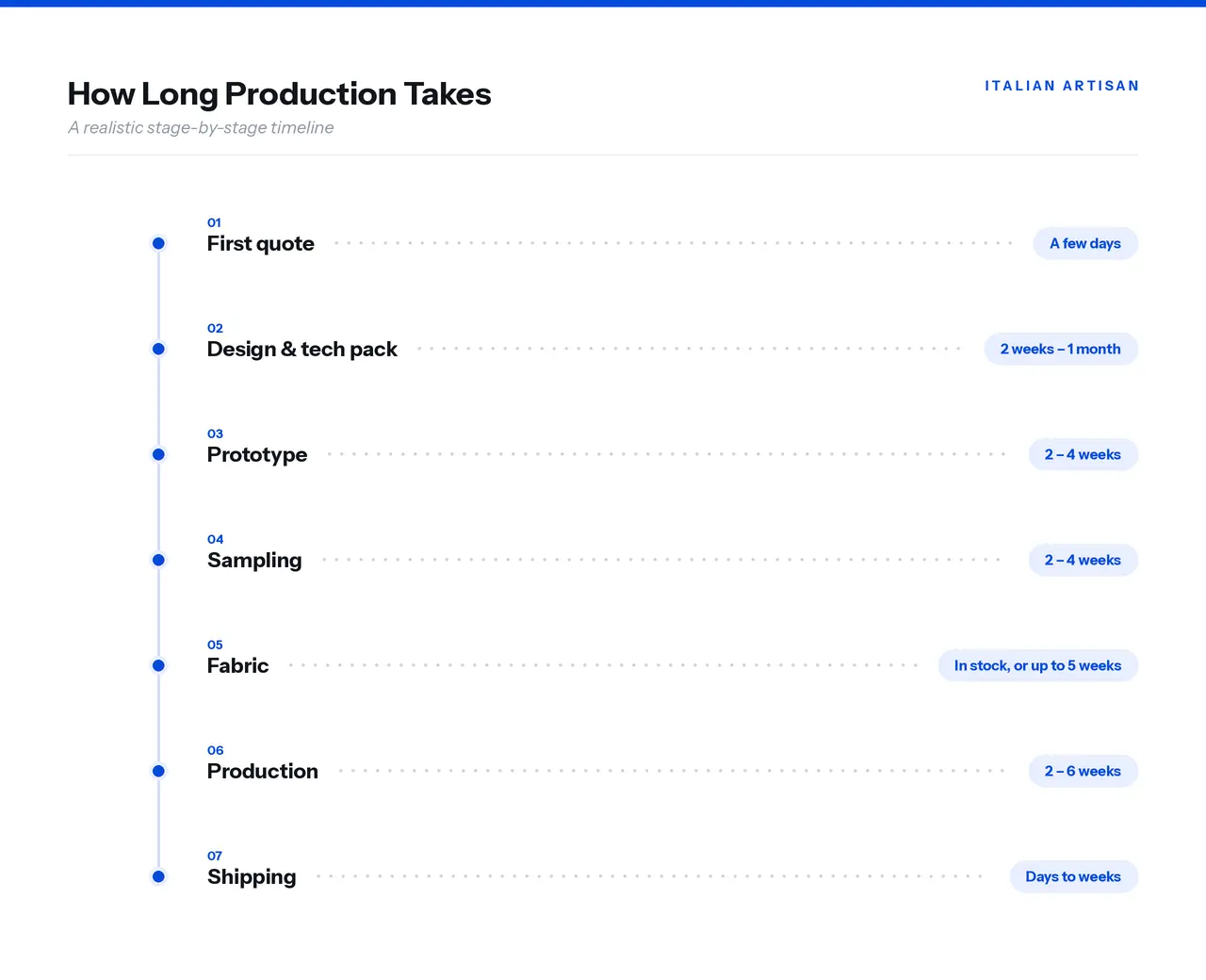
Here’s a realistic breakdown:
| Stage | Realistic time |
|---|---|
| First quote after your brief | A few days |
| Design and tech pack | 2 weeks to 1 month |
| Prototype | 2 to 4 weeks |
| Sampling | 2 to 4 weeks |
| Fabric | In stock, immediate; otherwise up to 5 weeks |
| Production | 2 to 6 weeks |
| Shipping | A few days to a few weeks, by destination |
A serious workshop returns a first quote within a few working days, and a first sample within two to four weeks once the fabric is in.
But the clock rarely stops where you’d expect.
“The slow part is almost never the sewing. It’s the brand changing its mind. Take the extra day to decide, then commit. And once the sample’s approved, go straight to production before you lose your slot.”
The real bottleneck is indecision. Brands change their mind a hundred times, even on small details, and everyone loses time. Better to take an extra day before you decide. Then give clear, settled direction.
One more timing trap: the gap after the prototype. If you approve a sample and then wait weeks to confirm production, you lose your slot. The factory moves on to other projects, and your timeline slips through no fault of theirs. For the full picture, see the clothing production timeline and our clothing manufacturing cost breakdown.
What Makes a Manufacturer Relationship Last?
The brands that build a manufacturer relationship that lasts treat the first order as the start of a partnership, not a transaction. They communicate clearly, pay on time, and grow volume with the same workshop instead of chasing the next cheapest quote.
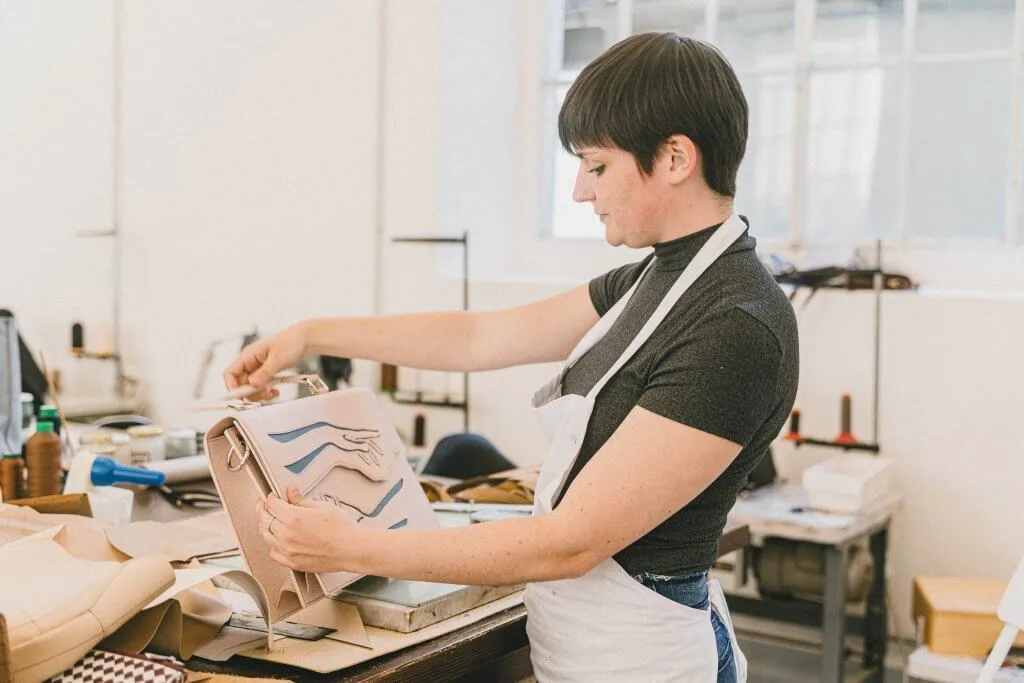
A one-off order is easy. A partner you keep for years is rarer, and far more valuable.
“The brands I keep working with are the ones who treat it as a relationship. They’re clear about what they want, they pay on time, and they grow with you instead of leaving for the next cheapest quote.”
Take Hagelstam, a brand that scaled with the same production base. What made it work wasn’t luck. The founders had their target customer and commercial strategy clear from the start. They knew a brand usually finds its feet around the third or fourth collection, so they planned for time. They understood their margins. And they pushed on every channel: e-commerce, partnerships, media, and PR.
The lesson is simple. The workshop is one half of the relationship. Your planning is the other.
When It Makes Sense to Work Through a Production Partner
Here’s the part no one tells you when you’re starting out: production is a job.
When you’re launching a brand and setting everything up for the first time, it takes patience and real competence. The unexpected is daily. A fabric runs late. A sample comes back wrong. A shipment gets stuck at customs. Someone has to own all of it, and at the start that’s usually full-time work.
So the real question isn’t only which manufacturer to use. It’s who is going to run the production.
For a new brand, the honest answer is often a partner. It keeps you from loading up on fixed costs before you’ve sold a thing. And it gives you one team to develop the concept, find the right workshop, manage the suppliers, run the manufacturer and the production, handle the paperwork and the shipping, and hold the deadlines.
“Most brands don’t struggle to find a factory. They struggle to find the right one, and to manage the production once it starts. That’s the gap we built Italian Artisan to close.”
That’s the role Italian Artisan plays. Every workshop on the platform is vetted, across clothing, knitwear, bags, and shoes, and every production gets its own project manager. In practice, that means:
- Concept and design support, so a finished tech pack isn’t a prerequisite. Around 80% of brands lean on the team for design too.
- Workshops matched to your product and your volume, so you skip the mismatch that costs most brands months.
- Sampling, quality control, suppliers, and shipping handled in one place, not chased across time zones.
- A single project manager on your production, from first sample to delivery.
- Clear payment terms: 100% upfront for prototypes, then 50% to start production and 50% on delivery. No paying in full for goods that arrive months later.
If that’s the kind of support you want for your next collection, you can request a quotation and get matched with a workshop that fits what you’re making.
Produce in Italy with a dedicated team
From the first sketch to the final delivery, we manage every step of your Made-in-Italy production, so you don’t have to.
- One dedicated project manager — no chasing workshops, no language barriers, no surprises
- End-to-end production — tech packs, sampling, manufacturing, quality control, shipping
- Curated network of Italian workshops — we select the right one for your product, you stay focused on your brand
No commitment.
FAQ
How do I find clothing manufacturers near me? Start with local directories, trade shows, and referrals from other founders nearby. Searching your product plus your city surfaces local workshops. But the right fit on product type, MOQ, and quality matters more than distance, and a managed partner can match you with vetted factories anywhere.
What’s the best clothing manufacturer for a startup? For most startups, a cut-and-sew or private label manufacturer that accepts small runs is the right start. Cut-and-sew gives you full design control; private label gets you to market faster and cheaper. The key is a workshop where your small first order still gets real attention.
What is a typical MOQ (minimum order quantity)? As a rule, expect to start around 50 pieces per style, though it varies by product. The driver is usually the fabric, since materials are sold in minimum quantities. You can make fewer, but very small runs get treated as samples and cost two to three times as much per piece.
How much does it cost to manufacture clothing? Per-unit cost depends on garment complexity, fabric, and order size, running roughly $15 to $45 for cut-and-sew in higher-cost markets and dropping as quantity rises. Budget for more than the unit price, though. Sampling, fabric, shipping, duties, labels, and packaging all add up.
Can I find a low-MOQ or small-batch clothing manufacturer? Yes. Smaller, family-run workshops in particular will take low minimums and small batches. The tradeoff is a higher price per piece, and very small runs are often treated as samples, which costs more. If small volume is your priority, look for a workshop set up for it.
What’s the difference between a private label and a cut-and-sew manufacturer? A private label manufacturer sells an existing product you rebrand and lightly customize, which is fast and low-cost. A cut-and-sew manufacturer builds garments from your own design and tech pack, giving full control over fit, fabric, and construction. Private label suits quick launches; cut-and-sew suits a distinct product.
Do I need a tech pack before contacting a manufacturer? Not necessarily. A tech pack or a detailed brief helps a factory quote accurately, but you don’t need one to start. Most manufacturers have in-house design support or partners who can help build it. An AI concept is a useful starting point, though it usually needs turning into a production-ready spec before sampling.
How long does it take to find a clothing manufacturer? Many brands spend three to six months searching, much of it on cold emails that go nowhere. Coming prepared shortens that: have your brief, target MOQ, fabric direction, and budget ready before reaching out. A managed partner can compress the search to weeks by matching you directly.