
Table of contents
2 – Where overseas production genuinely wins
3 – Where producing closer to home wins
4 – The factor most comparisons leave out: cash exposure
5 – Shipping, customs, and the container problem
6 – How to decide, on your own constraints
7 – Where Italy fits in this picture
8 – Frequently asked questions
TL;DR — The domestic vs overseas decision is rarely settled by quality, and it shouldn’t be settled by unit price alone. Overseas production genuinely wins on cost at high volume and on some specialised supply chains. Producing closer to home wins on small runs, payment terms, iteration speed, and logistics risk. The deciding factors for most brands are three: the minimum you have to commit to, how much cash you have to put up before you see anything, and how fast you need to fix a problem.
Most comparisons of domestic vs overseas clothing manufacturing get written to reach a conclusion the writer already had. Overseas is cheap and risky, domestic is expensive and safe, pick a side.
That framing is comfortable and not very useful, because both options genuinely win at different things, and which ones matter depends entirely on what you’re making and how much capital you can tie up.
So this guide sets out the real trade-offs on both sides, including the ones that favour producing far away. Then it gives you a way to decide based on your own constraints rather than on someone else’s conclusion. If you’re weighing up an Italian clothing manufacturer against an Asian one, this is the comparison to run first.
If you haven’t built a shortlist yet, our guide on sourcing a clothing manufacturer covers that step. This one is about deciding where to look in the first place.
What “domestic” and “overseas” actually mean for you
Start with the words, because they shift depending on where you’re sitting, and a lot of confusion comes from that.
For a US brand, domestic means manufacturing in the United States. The catch is that US apparel manufacturing capacity is thin, concentrated in a few categories, and often carries pricing and minimums that surprise brands expecting a like-for-like alternative. For a European brand, domestic might mean its own country, or the wider European market, which is a much deeper pool.
Which means the comparison most brands are actually running isn’t domestic against everything else. It’s this:
- Producing far away, in practice mostly Asia, where the majority of global apparel capacity sits.
- Producing closer to home, which for a European brand means Europe, and for a US brand usually means Europe or Latin America, since the domestic option is limited.
That’s the comparison this guide runs. Not because geography is the point, but because distance is what actually drives the differences that matter: how long a correction takes, how much you pay before you see the goods, and what happens when something goes wrong.
One thing to set aside early. This isn’t a quality argument. There are excellent factories in Asia and mediocre ones in Europe, and the reverse. Quality is a function of the individual workshop, what it specialises in, and how well you’ve vetted it. Distance changes other things.
Where overseas production genuinely wins
Any comparison that can’t name the advantages of the option it doesn’t sell isn’t worth reading. So here are the real ones, and they’re substantial.
- Unit cost at volume. The gap is real and it isn’t only labour. It’s scale, vertically integrated supply chains, and factories built to run tens of thousands of units of one style efficiently.
- Depth of capacity. If you need 20,000 pieces delivered on a fixed date, a large Asian factory can absorb that in a way most European workshops simply cannot. Capacity at that scale is concentrated there.
- Integrated material sourcing. In several hubs, the mill, the trim supplier, and the factory sit close together, sometimes under one owner. That shortens material lead times in a way that’s hard to replicate.
- Specialised categories. Some products are genuinely better served overseas. Technical performance fabrics, certain hardware, heavy embellishment and beading, and some sportswear constructions have their deepest expertise in Asia.
- Repeatability at scale. Once a style is tooled up and approved, large factories are very good at producing it identically, season after season.
Notice what all of these have in common. They’re advantages that grow with volume. A factory built for twenty thousand pieces is efficient at twenty thousand pieces, and that efficiency is exactly what you’re buying.
Which is also the honest limit of the argument. The same structure that makes overseas production strong at scale makes it awkward below it. The minimums exist because the economics require them, not because anyone is being difficult.
So if your order is large, your design is settled, and your product sits in a category with deep Asian expertise, the case for producing there is strong and this guide isn’t going to talk you out of it.
The rest of this guide is about what happens when one or more of those conditions doesn’t hold.
Where producing closer to home wins
The advantages on this side are the mirror image. They matter most when your volumes are moderate, your product is still evolving, or your working capital is finite.
- Minimums you can actually commit to. European workshops routinely start around 40 to 50 pieces, and made-to-order production can go down to single units. That difference decides whether a first collection is possible at all.
- Iteration speed. When a sample comes back wrong, the question is how fast you can fix it. Nearby, a corrected sample can move in days. Across an ocean, each round trip absorbs weeks, and sampling usually takes more than one round.
- Payment terms. Deposit-and-balance structures are normal, rather than paying the full amount before production starts. This one deserves its own section, and it gets one below.
- Direct contact. Overlapping working hours, fewer intermediaries, and the practical possibility of visiting the workshop. Being able to stand at the table and point at a seam solves problems that email rounds don’t.
- A shorter logistics chain. Road freight inside a single customs area versus sea freight, port handling, and customs clearance at both ends. Fewer steps, fewer things to go wrong.
- Legal proximity. Contracts, IP terms, and disputes handled inside a legal framework you can realistically use, rather than one you’d never enforce in practice.
And these advantages behave in the opposite way to the ones in the previous section. They shrink as volume grows. At twenty thousand units, a two-week correction cycle is a rounding error against the savings. At three hundred units, it can be the difference between hitting the season and missing it.
That symmetry is the whole decision in one line. Overseas advantages scale up. Nearby advantages scale down. Where you sit on that curve is the answer.

The factor most comparisons leave out: cash exposure
Nearly every domestic versus overseas comparison is argued on unit price. But unit price is not what constrains most growing brands. Working capital is.
Two things decide how much cash a production ties up: the minimum you have to order, and when you have to pay for it. Overseas, those two often compound, because larger minimums are frequently combined with payment terms that ask for the full amount before anything is made.
Here’s how that felt to a brand owner who went through it:
“For me the problem was never quality. With testing and research I found someone who satisfied me. The real limits were the minimums, which for my type of product were 500 pieces per colour, and the exposure of my cash, because I had to pay 100% upfront. So I was paying thousands of euros to receive the product four months later. That created stress on two levels: the worry, because anything can happen in between, and the cash itself.”
Read the first line again, because it’s the part that gets misrepresented in most articles on this subject. Quality wasn’t the issue. She tested, she researched, she found a factory that met her standard. The constraints were structural.
And notice how the two constraints multiply rather than add. A 500-piece minimum per colour is manageable on its own. Full payment upfront is manageable on its own. Together, across three colourways, you’re committing the cash for 1,500 units before a single one exists, and then waiting months to see them.
That exposure costs you twice.
- The financial cost. Money committed to inventory that doesn’t exist yet is money you can’t spend on marketing, samples, or the next drop. For a young brand, that’s often the constraint that decides how fast it can grow.
- The leverage cost. This one is less obvious and it matters more. Once you have paid in full, your ability to get a problem corrected depends entirely on the supplier’s goodwill. A deposit-and-balance structure keeps something on the table until the goods are right.
Compare that with a staged structure, which is normal closer to home. A deposit reserves your slot in the production calendar and is deducted from the total, with the balance falling due as production completes. Your cash goes out in steps, alongside the work, and you keep some leverage until the end.
To be fair about it: not every overseas supplier asks for 100% upfront, and terms improve considerably once you have a track record with a factory. But a first-time buyer placing a modest order is exactly the party with the least negotiating power, which is when the terms are hardest and the exposure is highest.
So when you compare quotes, compare the cash profile alongside the unit price. How much has to leave your account before anything exists, and how long is it gone for. Two quotes with the same per-unit figure can carry completely different risk.
Shipping, customs, and the container problem
Distance shows up on your calendar and in your risk register long before it shows up in the landed cost. Three things are worth understanding before you commit.
Sea freight takes real time
Ocean freight from Asia to Europe is measured in weeks, not days, and that’s only the sailing. Add booking, port handling at both ends, customs clearance, and inland transport, and the door-to-door figure is longer than the schedule usually suggests.
That time sits on top of production, not inside it. So when a factory quotes you a production lead time, ask separately how long the goods then take to reach you, because those two numbers get quoted separately and only one of them usually makes it into the plan.
Air freight exists, and it’s the standard rescue when a season is slipping. Just do the arithmetic before you rely on it. Air freighting a bulk order can absorb a large share of the unit-cost saving that justified producing far away in the first place. A cost advantage that survives only as long as nothing goes wrong isn’t a very robust one.
Customs has to be actively managed
Crossing a customs border means paperwork that has to be right: classification codes, declared values, certificates of origin, and a clear answer to who is the importer of record, meaning who is legally responsible for the goods and for paying duty at the destination.
None of this is exotic, and thousands of shipments clear every day. But it isn’t automatic either. An incorrect code or a missing document holds goods at the border, and a hold at the border is a delay you can’t shorten by working harder.
Duty rates matter too, and they depend on the origin, the destination, and whatever trade agreements sit between them. A duty rate that changes your landed cost by several percentage points belongs in the comparison, not in a footnote.
One honest caveat here. Producing closer to home doesn’t automatically mean no customs. Moving goods within the EU is a single-market movement, but a shipment from Italy to the UK, Switzerland, or the United States crosses a border and needs proper handling like any other. What changes with distance is the number of steps, not always their existence.
A container is a single point of failure
This is the part brands underestimate. Sea freight concentrates your entire production into one shipment, on one vessel, at one moment.
Most of the time that’s fine. But the failure modes are real, and they take the whole order with them: water ingress damaging goods, a container mis-stowed or lost, port congestion, industrial action, a vessel rerouted. If your season is in that box, the box is your season.
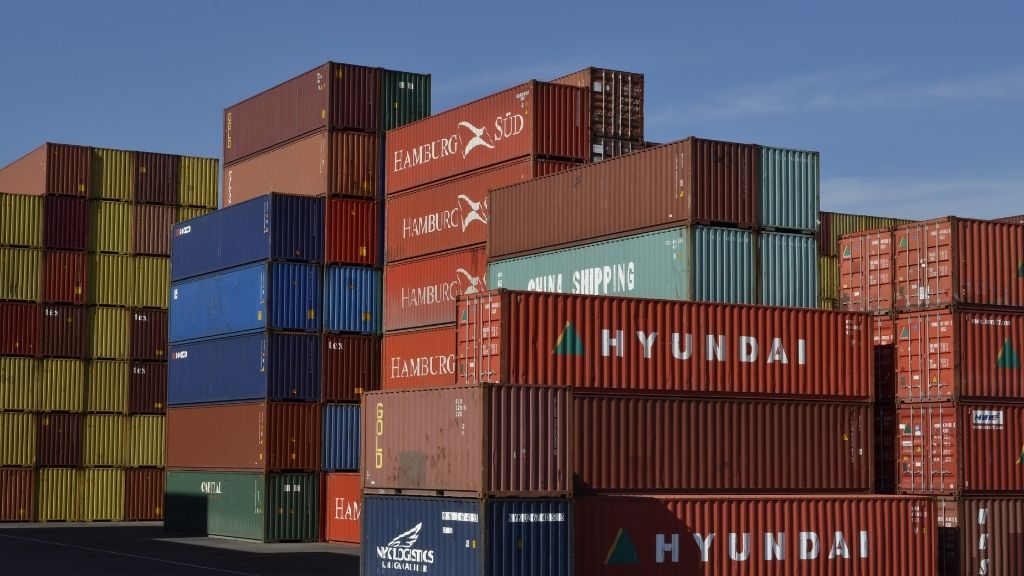
Which is why insurance belongs in the conversation, and why the useful question isn’t whether there is cover, but what it actually covers and at what declared value. Cover that pays out a fraction of the commercial value of a lost order isn’t real protection.
Shorter, road-based logistics doesn’t remove risk. It splits it into smaller pieces, moves it over shorter distances, and makes recovery faster when something does go wrong.
How to decide, on your own constraints
Put the two sides together and the decision stops being a matter of opinion. Overseas advantages grow with volume. Nearby advantages grow as volume falls, as iteration increases, and as available cash tightens.
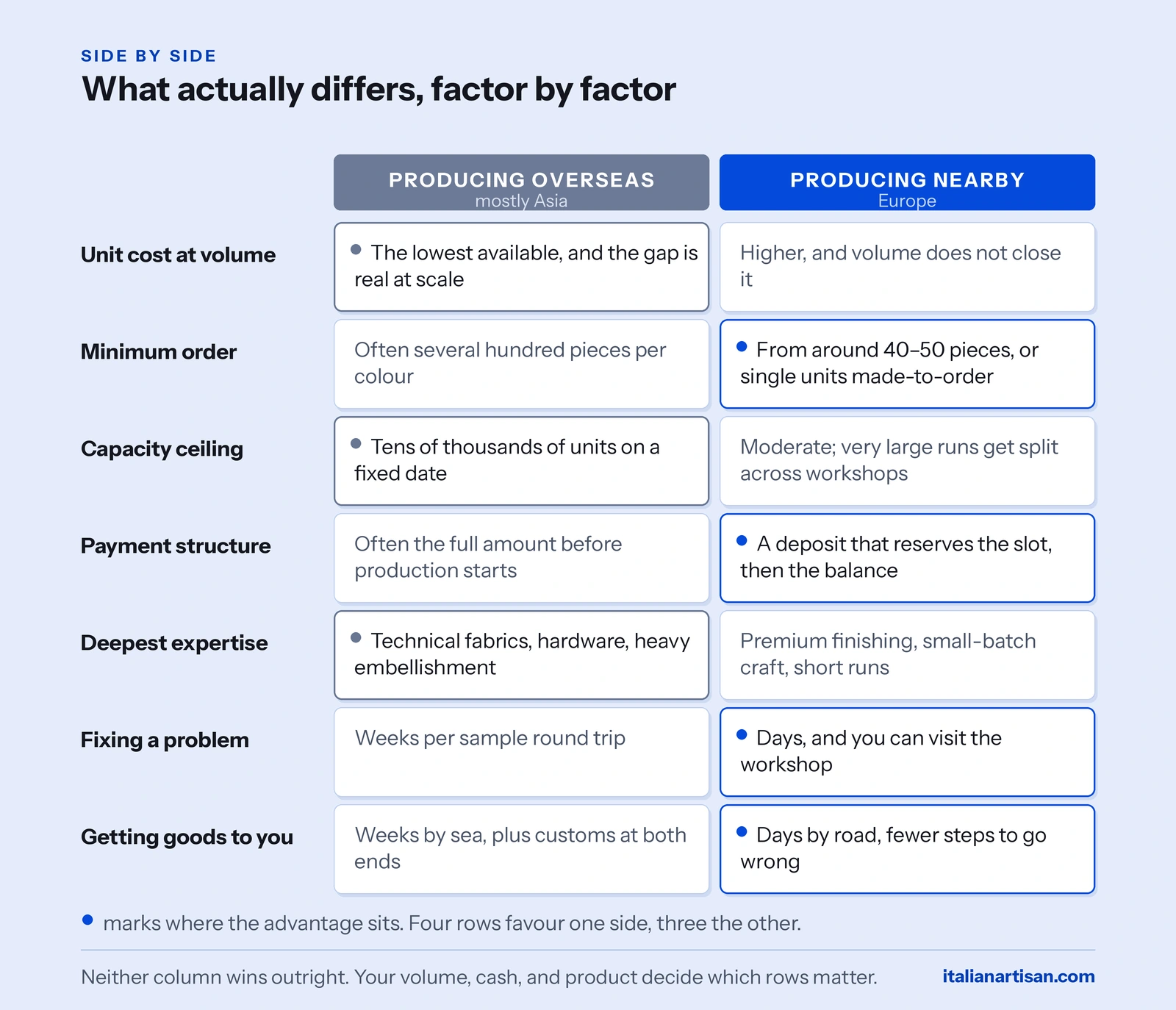
In practice, three questions settle it for most brands.
- What minimum can you commit to? Not what you’d like to order. What you can commit to, per style and per colour, without gambling the business.
- How much cash can you put up before goods exist, and for how long? This is the question that decides more sourcing outcomes than unit price does.
- How settled is your product? A design that will change over the next two seasons costs far more to iterate at a distance.
Then map your situation against the pattern:
| If this describes you | Lean toward | Because |
|---|---|---|
| Thousands of units per style, design already settled | Overseas | The cost advantage is real at that scale, and iteration risk is low |
| First collection, or testing whether a product sells | Closer to home | Minimums are reachable and mistakes stay small |
| Cash is your binding constraint | Closer to home | Staged payments keep money in the business, and keep you some leverage |
| Technical fabrics or constructions with deep Asian expertise | Overseas | Specialisation beats proximity when the capability only exists in one place |
| A fixed launch date with no slack | Closer to home | Shorter logistics, and corrections measured in days rather than weeks |
| Unit cost is the main driver of your margin | Overseas | At volume, nothing closes that gap |
Most brands find their rows point in one direction, and that’s the answer. If yours are split, the split itself is informative, and it usually means volume is the deciding variable: you’re either not yet big enough for overseas economics to pay off, or you’ve outgrown the reason you were producing nearby.
Which points at the option nobody frames as an option. You don’t have to choose once, for everything.
Plenty of established brands split their sourcing deliberately. High-volume basics, where the design is fixed and cost drives margin, go to a large factory overseas. Premium pieces, short runs, and anything still evolving stay closer to home, where a correction takes days. That isn’t indecision. It’s matching each product to the structure that suits it.
And it’s worth remembering that the decision isn’t permanent. Brands move production as they grow, and they move it back when a category needs more attention than distance allows.
The Sourcing Decision Worksheet
Score your own situation across the factors in this guide, including the cash exposure most comparisons leave out, and see which way your constraints actually point.
Download the worksheet (PDF)Where Italy fits in this picture
Italy sits firmly on the nearby side of the comparison, and it’s worth being precise about which of those advantages it delivers, rather than claiming all of them.
What it does well is the profile this guide has been describing. Minimums that a growing brand can commit to, often from around forty to fifty pieces, and single units in made-to-order. Staged payment structures rather than full payment upfront. Correction cycles measured in days. And a depth of specialised workshops in clothing, knitwear, bags, and shoes that suits premium products where the finish is part of what you’re selling.
What it doesn’t do is compete on unit cost at high volume. If your comparison came out on the overseas side, Italian production won’t change that arithmetic, and nobody should pretend otherwise.
The reason this comes up here is that most brands looking at Italy aren’t choosing on price. They’re choosing because their product needs a level of making that justifies the cost, and because the operational profile fits how they actually run: modest runs, real iteration, and cash that stays in the business until the work is done.
That’s the case producing in Italy makes. Not cheaper, and not better in the abstract. Better matched to a particular set of constraints, which may or may not be yours.
See what your production would actually look like in Italy
Tell us what you’re making, your volumes, and your timeline. We’ll come back with the real minimums, the payment structure, and the lead time, so you can compare it against your overseas quote on equal terms.
- Minimums you can commit to — from single made-to-order pieces to full production runs
- Staged payments — a deposit that reserves your slot, not the full amount before anything exists
- One project manager — handling the workshop, the timeline, and the shipping paperwork
No commitment.
Frequently asked questions
Is it cheaper to manufacture clothing overseas?
At high volume, usually yes, and the gap is real. But the unit price isn’t the whole cost. Add freight, duties, customs handling, and the cash you tie up paying upfront for goods that arrive months later. At moderate volumes those additions narrow the gap considerably, and sometimes close it.
Is quality better in Europe than in Asia?
No, not as a rule. There are excellent factories in Asia and mediocre ones in Europe, and the reverse. Quality depends on the individual workshop, its specialisation, and how well you vetted it. What distance really changes is minimums, payment terms, iteration speed, and logistics risk.
Do overseas manufacturers require payment upfront?
Full payment before production is common for new buyers placing modest orders, though terms improve once you have a track record. Closer to home, a deposit-and-balance structure is more typical. The difference matters twice: it decides how much cash you tie up, and how much leverage you keep if something needs correcting.
What are typical minimum order quantities overseas versus in Europe?
Overseas minimums often run into the hundreds per colour, and for some products several hundred. European workshops commonly start around forty to fifty pieces, with made-to-order production going down to single units. For a first collection, that difference frequently decides what’s possible at all.
How long does shipping take from Asia?
Sea freight is measured in weeks, and that’s just the sailing. Booking, port handling at both ends, customs clearance, and inland transport all sit on top. Air freight is much faster but expensive enough that using it to rescue a delayed order can absorb much of the saving that justified producing far away.
Can I use both domestic and overseas manufacturers?
Yes, and many established brands do it deliberately. High-volume basics with settled designs go overseas where cost drives margin, while premium pieces, short runs, and anything still evolving stay closer to home. It isn’t indecision, it’s matching each product to the structure that suits it.