
Table of contents
2 – Start with size: are you and the workshop a match?
3 – Match the production model to what you can supply
4 – Specialization beats general capability
5 – Check availability before you commit
6 – Budget fit is about order value, not unit price
7 – The tiebreaker: how they handle a problem in your brief
8 – How to actually make the call
9 – When matching is the service
10 – Frequently asked questions
TL;DR — To choose a clothing manufacturer, check five things: their capacity against your volume, their production model against what you can supply, their specialization against your product, their availability against your calendar, and the order value they need against your budget. There is no best manufacturer, only the right fit for your brand. And when something has to give, give on price, never on size or availability.
By the time you’re choosing, the hard filtering is behind you. You have two or three manufacturers who are real businesses, who can make your product, and who haven’t raised any warning signs. Now you have to pick one.
And the question changes. Until now you’ve been asking whether a manufacturer is good. From here you’re asking whether they’re right for you. Those aren’t the same thing, and the gap between them is where a lot of brands make an expensive mistake.
So this guide is about how to choose a clothing manufacturer on fit. Five things need to align, and there’s an order to checking them.
If you’re still building the shortlist, start with our guide on how to find a clothing manufacturer. This is the step after that.
What makes a clothing manufacturer the right one?
The right clothing manufacturer is the one that fits your volume, your product, your calendar, and your budget. Not the one with the best reputation, and not the one with the lowest quote. Fit is a technical judgment, and it gets made on specifics.
Here’s how that judgment actually gets made when a new project comes in:
“Our historical data helps me narrow the options, but the first thing I look at is whether the brand and the workshop are the same size. You can’t ask a two-person workshop to produce thousands of pieces, and you can’t ask a large factory to run fifty units. Then I look at price and craft level, because within the same product category workshops have different specializations and different target markets. Then availability. Some workshops would be perfect, but they’re full, and they can’t start for weeks.”
Notice the order. Size comes first, because it’s the one thing goodwill can’t fix. And availability comes last on the list but decides your season, which is why it’s the criterion brands forget until it’s too late.
These are the five alignments to check:
- Size: Your order volume against their real capacity.
- Production model: What you can supply against what they expect you to bring.
- Specialization: Your product against what they make every day.
- Availability: Their calendar against yours.
- Order value: Your budget against the value a job needs to be worth to them.
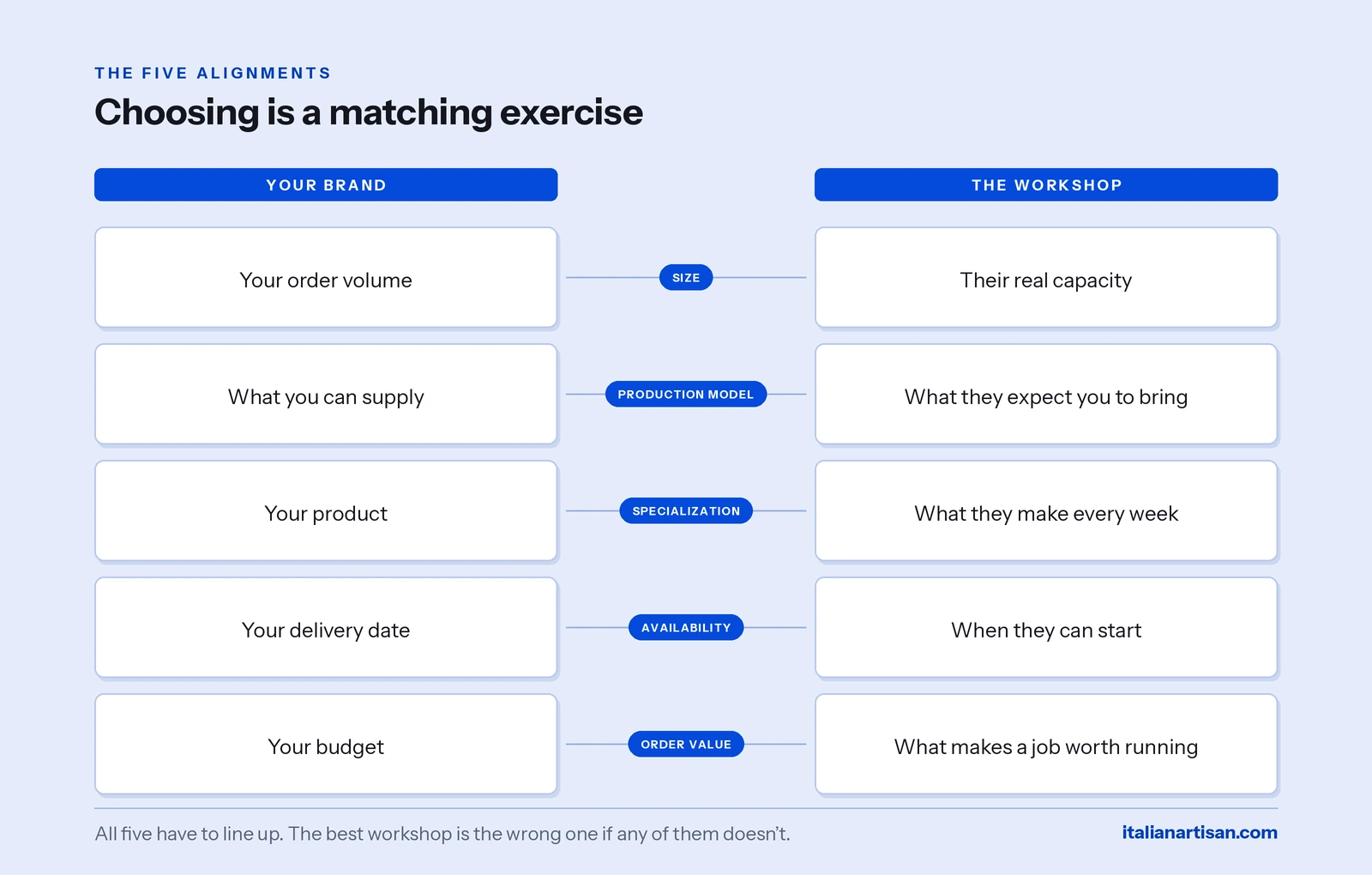
The rest of this guide takes them in that order.
Start with size: are you and the workshop a match?
Size alignment comes first because it’s the one mismatch that effort can’t solve. A workshop either has the capacity for your order or it doesn’t, and no amount of enthusiasm on either side changes that.
The mismatch runs in both directions, and each one fails differently.
When you’re too big for the workshop
Ask a two-person atelier for three thousand pieces and one of two things happens. They decline, which is the good outcome. Or they accept, and then quietly send the overflow to workshops you’ve never seen, so you lose control of the quality you spent weeks verifying.
Even without subcontracting, saturating a small workshop is risky. Your order becomes their entire calendar, so a single machine breakdown or one sick pattern cutter puts your whole season at risk.
When you’re too small for the factory
The opposite mismatch is quieter, and more common for young brands. A fifty-piece order inside a factory built for thousands is not a bad order. It’s just never the urgent one.
You’ll notice it in the small things first. Slower replies, sampling that slips a week, a delivery date that moves because a larger client needed the line. Nobody is treating you badly, you’re simply not the order that decides their month.
So look for a workshop where your order is meaningful without being overwhelming. Big enough that they care about keeping you, small enough that they can absorb you comfortably.
Match the production model to what you can supply
The production model decides how much of the work lands on your desk. It’s the difference between sending a tech pack and waiting, and sourcing every metre of fabric yourself before anyone cuts anything.
Three models cover most of the market, and each one expects something different from you:
| Model | What you bring | Typical minimum | Choose it when |
|---|---|---|---|
| Made-to-order | Your spec, often your fabric too | None. Single pieces are possible | You’re testing a product, or selling made-to-measure |
| CMT, also called façon (cut-make-trim) |
The fabric, the trims, and a complete tech pack | Around 40 pieces per color | You already have fabric sourcing you trust |
| Full package (the workshop sources for you) |
The tech pack and the brief | Around 50 pieces | You want sourcing handled, and you’re willing to pay for it |
Those minimums aren’t arbitrary. The 40-piece figure in CMT comes from the smallest roll a mill will sell, so it’s really the fabric setting the floor rather than the workshop. Knitwear and heavily customized products tend to sit higher, and the sharpest per-unit pricing usually appears once you cross a few hundred units.
Here’s the part brands get wrong. The model isn’t really a preference, it’s a consequence of what you can actually supply.
CMT looks cheaper on paper, because you’re only paying for labor. But it only works if you can source fabric and trims reliably, on time, in the right quantity. If you can’t, CMT isn’t a saving. You’ve just moved the hardest and riskiest part of production onto yourself, and a delay in your fabric becomes a delay in your delivery.
So be honest about your own capability before you pick a lane. A brand with an established mill relationship and a brand launching its first collection should not choose the same model, even if they’re making the same garment.
Specialization beats general capability
Two workshops can both be listed as clothing manufacturers and share almost nothing in practice. One makes tailored outerwear every week. The other makes jersey basics. Both can technically take your order, and only one of them should.
The gap shows up as soon as the work starts. A workshop that makes your kind of product every week already knows where it goes wrong, so they ask sharper questions, they catch the problems in your tech pack, and their first sample lands closer to your spec. A capable generalist gets there eventually, but you pay for the learning in sampling rounds and lost weeks.
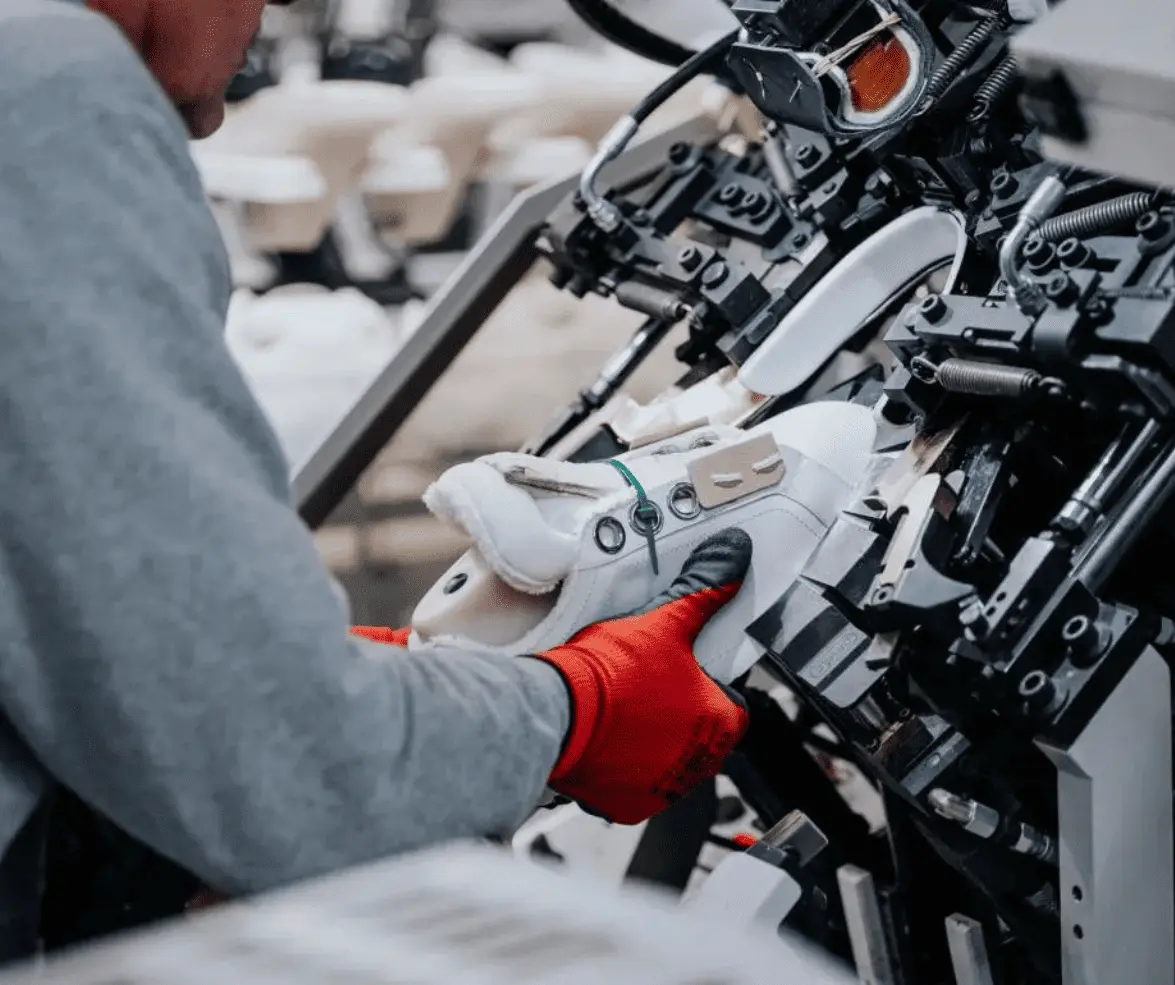
Some of this is machinery, and machinery isn’t negotiable. Fully fashioned knitwear, where each panel is knitted to shape instead of cut from a length of fabric, needs equipment a cut-and-sew workshop simply doesn’t own. No amount of skill substitutes for the machine.
The rest is craft level and target market, and this is where “the best workshop” becomes the wrong idea entirely. A workshop whose clients are luxury houses works to that standard and prices to it. If you’re building a contemporary brand, you may be paying for finishing your product doesn’t need and your customer will never notice. The mismatch runs the other way too. If your positioning is luxury and their usual client sits in the mid-market, the finishing won’t hold up next to what you’re promising.
So test specialization directly:
- What do you make most weeks? Not what they’re able to make. What actually moves through the workshop.
- What have you made recently that’s closest to my product? Then ask to see it, or to see photos of it.
- Who are your typical clients? The answer tells you the standard and the price level they’re built around.
You’re not looking for the most impressive answer. You’re looking for the closest one to what you’re actually making.
Check availability before you commit
This is the criterion almost nobody writes about, and it’s the one that decides whether you deliver on time. A workshop that fits perfectly on every other measure is still the wrong choice if it can’t start until October.
Good workshops are usually full. That isn’t a problem with them, it’s a consequence of being good, and it should mildly reassure you. But it doesn’t help you if your delivery date is already fixed.
The mistake most brands make is asking the wrong question. They ask how long production takes, hear six weeks, and build the calendar on that number. The more useful question is when the workshop could start. Those are two different figures, and what matters is both of them added together.
So separate them out explicitly:
- Start date: When your job actually enters their calendar. This is the number that tends to stay hidden.
- Lead time: How long the work takes once it has started.
- Sampling time: Which comes before both, and sits in its own queue.
Then check that calendar against your season. Workshops fill up ahead of the main delivery windows, so the same producer who could start next week in January may be booked solid by March.
And when you find the right fit, hold the slot. Paying a deposit to reserve production capacity, on top of the prototyping cost and deducted from the final total, is normal practice and it protects your date. If nobody offers it, propose it yourself.
Budget fit is about order value, not unit price
Budget alignment isn’t about finding the lowest price per piece. It’s about whether your order is worth running for them, and worth making for you. Those two things are decided by the total value of the job, not by the unit cost.
“More important to me than MOQ is minimum order value.”
That’s the whole point in eight words. A workshop’s setup costs barely move with quantity, since the pattern, the sampling, the marking, and the machine setup take similar effort for forty pieces or four hundred. So what they’re really weighing is whether the job justifies the slot it occupies in their calendar.
Which means “what’s your minimum?” is often the wrong question. A workshop may happily take thirty pieces of a tailored coat and turn down two hundred basic tees, because one order is worth running and the other isn’t. Ask instead what order value makes a job worth doing for them, and you’ll get a far more honest answer about whether you fit.
The same logic applies to your own budget, and the quantity you commit to changes it more than most brands expect. In one real quote we received, a blouse cost €65 per piece at fifty units, and €58 per piece at a hundred. So a manufacturer isn’t simply affordable or expensive. Whether you can afford them depends on how much you order.
And sometimes the fix isn’t the quantity, it’s the product. A streetwear brand we worked with compared three versions of the same hoodie: a white-label piece at around €21, the same piece with a custom back print and branded label at around €25, and an oversized cut at around €60. The oversized version was dropped, not because the workshop was wrong, but because that silhouette didn’t fit the budget. The other two did.
So before you rule a manufacturer out on price, check whether a different specification puts them back inside your range.
The tiebreaker: how they handle a problem in your brief
Suppose two candidates fit on all five criteria. Similar size, right model, real specialization, workable calendar, sensible pricing. Something still has to decide it.
Give them the hardest part of your brief and watch what comes back. Every brief has one: a construction that’s awkward, a material that fights the shape, a detail that costs more than it’s worth.
You’ll get one of three responses:
- They say yes to all of it. The least useful answer, because nothing in your brief was examined.
- They say it can’t be done. Honest and worth something, and better than discovering it at sampling.
- They propose an alternative. The one you want.
We had a call recently where a client’s own design turned out not to be practically makeable. The producer proposed a modification on the spot, and the client accepted it in five minutes. That exchange is what you’re actually buying when you choose well, and no quote sheet will show it to you.
There’s a mindset behind that behavior, and the good makers describe it plainly:
“When we start a new job with a new brand, I invest in the brand. We put in all our experience, over fifty years of it, our time and our enthusiasm.”
That’s the difference between a supplier and a partner. A supplier executes what you send. A partner tells you when what you sent is going to cost you, and offers a way around it.
You’ll pay for that difference, and it’s usually worth it. First collections in particular tend to change during sampling, and a workshop that helps you change them well saves more money than a lower unit price ever will.
How to actually make the call
By now you have the information. What’s left is weighing it, and the weights aren’t the same for every brand. What matters most depends on the constraint you’re actually under.
| If this is your situation | Weight heaviest | Let this one go first |
|---|---|---|
| First collection | Specialization, and how they handle problems | Unit price |
| Fixed launch date | Availability | Nearly everything else |
| Scaling a proven product | Size fit and spare capacity | Craft level beyond what you need |
| Tight budget | Order value fit | Craft level beyond what you need |
Then put the candidates side by side. Not in your head, on paper. Scoring two or three workshops across the five alignments takes fifteen minutes, and it usually surfaces the thing you’ve been avoiding, which is that one candidate is winning on charm rather than on fit.
You’ll almost never get a perfect score on all five. Something gives, and the only real question is what.
Compromise on price, and on craft level that sits above what your product needs. Both of those cost you money, and neither one breaks the collection.
Don’t compromise on size or availability. Those two don’t fail gradually. They fail at the worst possible moment, when the season is already committed and there’s no time left to recover.
And once the answer is clear, commit. Deliberating past the point where you have the information doesn’t buy you certainty. It costs you the calendar slot, and the workshop you were weighing up gets booked by a brand that decided faster.
The Manufacturer Comparison Scorecard
Score up to three workshops across the five alignments, side by side, on one page. Print it and fill it in as the answers come back.
Download the scorecard (PDF)When matching is the service
The five criteria in this guide take ten minutes to learn. The judgment behind them takes considerably longer, because fit is comparative. You can only tell whether a workshop is the right size for your brand if you know what the alternatives look like.
And that’s the real constraint. You’re choosing between two or three workshops you’ve known for a few weeks. Someone who assigns projects every week is choosing from a set they’ve watched deliver, season after season, and they already know which workshop takes fifty pieces happily and which one needs three hundred to be worth the slot.
That’s the work a managed production partner does before you ever see a shortlist. It’s the process Irene described at the top of this guide, running on accumulated data rather than on first impressions.
This is the role Italian Artisan plays. Your brief gets matched against workshops across clothing, knitwear, bags, and shoes whose size, specialization, standard, and current calendar are already known, and every production gets a project manager who knew the workshop before your order arrived.
It won’t suit everyone. If you have the relationships and the time to build them, choosing yourself gives you the most control, and this guide is how to do it well. But if you’d rather not learn the map one mistake at a time, matching is a service worth buying.
Get matched with the right Italian workshop
Tell us what you’re making, how much of it, and when you need it. We match your brief against workshops whose size, specialization, and calendar we already know.
- Matched on real data — size, specialization, availability, and order value, not first impressions
- A workshop that fits your stage — from a single prototype to full production runs
- One project manager — who knew the workshop long before your order arrived
No commitment.
Frequently asked questions
How do I choose between two clothing manufacturers?
Score both across five alignments: size, production model, specialization, availability, and order value. If they still tie, give each one the hardest part of your brief and see which proposes a solution instead of simply agreeing. When you have to compromise, compromise on price, never on size or availability.
What matters most when choosing a clothing manufacturer?
Size alignment. A workshop that’s too small for your volume will either subcontract or fall behind, and a factory that’s too large will keep pushing you behind bigger clients. Specialization and availability come next, and unit price matters less than most brands assume.
Should I choose the manufacturer with the lowest price per piece?
No. Unit price is only part of the picture, because pattern work, sampling, and machine setup cost roughly the same at any quantity. What matters more is whether your total order value makes the job worth running for them, and whether the workshop actually fits your product and your calendar.
Is a large factory better than a small workshop?
Neither is better in itself. What matters is whether your order is the right size for them. A small atelier suits low volumes and prototypes, a larger factory suits repeat production at scale, and being badly matched to either one produces the same result: your order stops being a priority.
What should I do if the right manufacturer isn’t available in time?
Ask when they could realistically start, then decide whether your date can move. If it can’t, a workshop that fits slightly less well but can start on schedule is usually the better choice, since availability problems can’t be fixed late in a season. If you can wait, secure the slot with a deposit.
Can I work with more than one clothing manufacturer?
Yes, and many brands do, usually splitting by category so that knitwear, outerwear, and jersey each go to a specialist. Just count the cost. Every additional manufacturer adds sampling rounds, quality checks, and coordination, so more suppliers means more of your own time spent managing them.