
Table of contents
2 – Who designs the product?
3 – Who buys the materials?
4 – How the two axes combine
5 – OEM, ODM, and the other acronyms
6 – What each type asks of you
7 – Producing in Italy across these types
8 – Frequently asked questions
TL;DR — Manufacturer “type” answers two separate questions: who designs the product, and who buys the materials. On design, you’re either taking a workshop’s catalogue product and putting your brand on it, or commissioning something custom from your own tech pack. On sourcing, either you supply the fabric (CMT) or the workshop supplies everything (full package). Every label you’ll come across, including OEM, ODM, and cut-and-sew, is a combination of those two answers. Minimums follow the same logic, from single pieces in made-to-order to around forty per color in CMT and around fifty in full package.
Start looking for a clothing manufacturer and you’ll hit a wall of labels. CMT, full package, private label, white label, OEM, ODM, cut-and-sew. They get presented as one long list, as if they were all the same kind of thing.
They aren’t. That list mixes two different questions together, which is why it never quite makes sense however many times you read it.
Split the questions and the whole vocabulary falls into place. One question is about your design. The other is about your materials. Everything else is a name for a particular combination of the two.
This guide sorts out the types of clothing manufacturers on that basis, with real minimums and real prices attached to each one. By the end you’ll know which model your product needs, and what each one will ask of you before a clothing manufacturer can quote it.
What “type” actually means
A manufacturer’s type is defined by two things: how much of the design is yours, and how much of the sourcing is theirs. Those two are independent, so a workshop’s position on one tells you nothing about its position on the other.
Here are the two questions in full.
Who designs the product? At one end you bring a finished design and a tech pack (the technical document that tells the factory how to make it), and the workshop builds exactly that. At the other end the workshop already has the product, and you put your label on it. In between sits everything else.
Who buys the materials? At one end you buy the fabric, the linings, the zips, and the buttons, and you ship them in. At the other end the workshop buys all of it and quotes you a single price per garment.
Both questions matter for different reasons. The design question decides how much control you have over the product and how distinctive it can be. The sourcing question decides how much operational work sits on your desk, and how much risk you carry if a material arrives late.
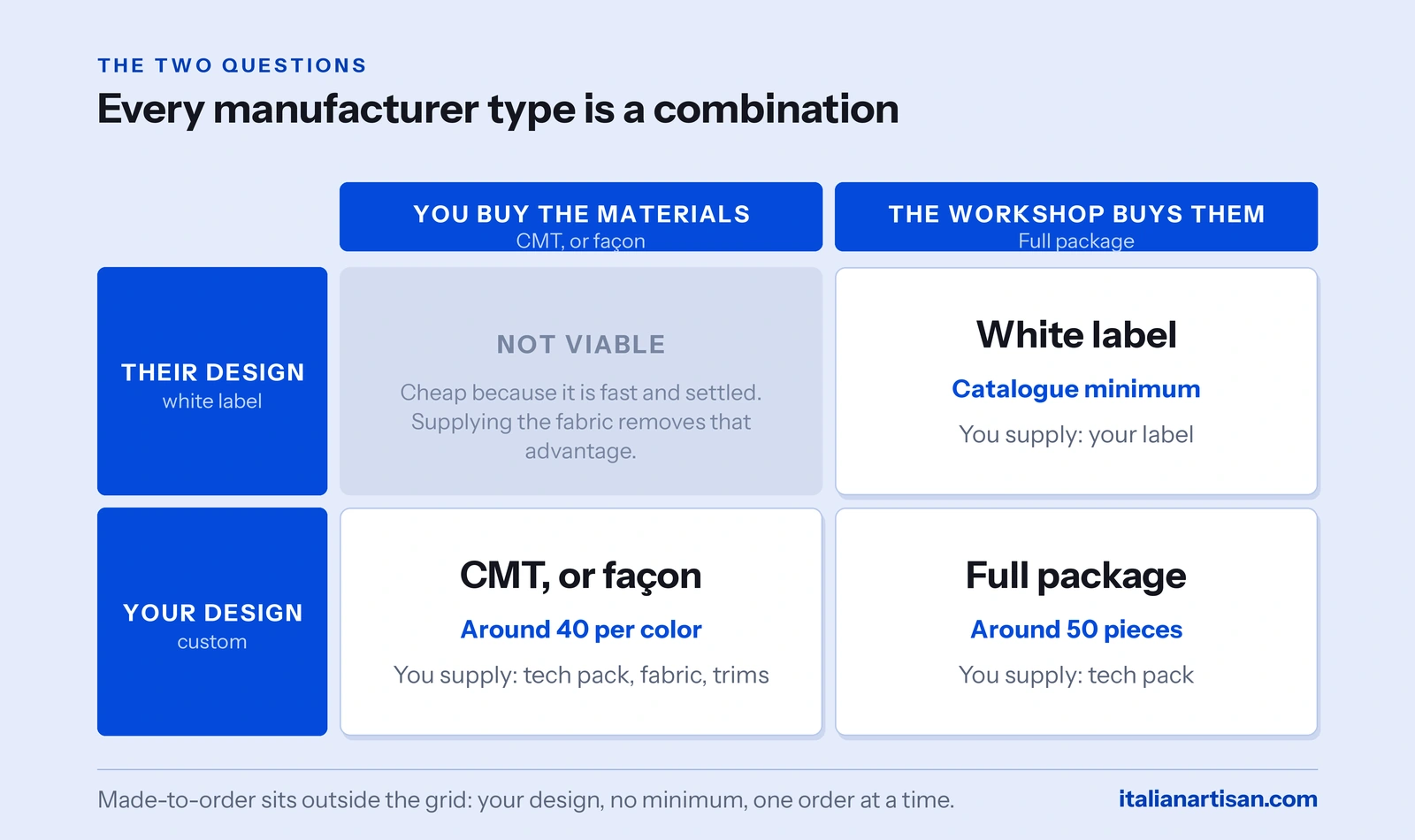
Notice that not every combination makes commercial sense. A catalogue product is built around materials the workshop has already chosen, so supplying your own fabric for one is rarely on the table. That’s why the vocabulary feels uneven: some names describe a single cell, and others describe a whole column.
The next two sections take each question in turn. Then we put them back together with the minimums and prices that come with each combination.
Who designs the product?
The design question has two real answers, with a stretch of middle ground between them. At one end the product already exists and you add your brand. At the other, nothing exists until you commission it. Control, cost, and lead time all rise together as you move from the first toward the second.
White label: their product, your label
A white label product is one the workshop already makes and sells to several brands. You pick it from a catalogue, put your label in it, and order. Nothing about the garment itself is yours.
It’s the fastest and cheapest way to a finished product. There’s no tech pack to write and no development to pay for, because the pattern, the fit, and the fabric were all settled before you arrived.
Many catalogues do allow some change, within limits the workshop sets. You might move from a smooth leather to a hammered one, choose a different color, or add your own print and label. How far that goes varies a lot, so ask early which elements are open and which are fixed.
The trade-off is obvious once you say it out loud. The same garment is available to anyone else who asks, including your competitors. That makes white label a sensible way to test a market, fill a gap in a range, or produce merchandise, and a poor way to build a product people recognize as yours.
Custom manufacturing: your design, from scratch
Custom production, often called cut-and-sew manufacturing, means the product doesn’t exist until you commission it. You bring the design and the tech pack, the workshop develops the patterns, makes samples, and then produces.
This is where the control is. It’s also where the cost and the time are, because pattern making, grading, and two or three sampling rounds all happen before a single sellable unit exists.
What the spectrum costs, in real numbers
You can watch the whole axis in one real example. A streetwear brand priced the same hoodie three ways:
- The catalogue piece, unchanged: around €20.80 each. Pure white label.
- The same piece with a large back print, a logo, and a custom “Made in Italy” label: around €25 each. White label with customization.
- A different fit, with wider shoulders and a looser cut: around €60 each. This one crosses into custom, because a new fit means new patterns.
The price roughly tripled from the first option to the third. And the fabric didn’t change, the factory didn’t change, and the garment was still a hoodie.
What tripled was the design work. That’s the single most useful thing to understand about this axis: when a quote comes back higher than you expected, the gap is usually development, not materials.
Who buys the materials?
The second question is less glamorous and more operational. It decides how much buying, chasing, and shipping you do before production can start, and who is responsible when a material turns up late or wrong.
CMT: you supply the materials
CMT stands for cut-make-trim, and it’s also called façon in parts of Europe. The workshop supplies labor, machines, and skill. You supply everything else: the fabric, the lining, the zips, the buttons, and the labels, delivered to their door before anyone starts cutting.
Minimums here have an unusual property. They aren’t really set by the workshop at all. A common CMT minimum is around forty pieces per color, and that number comes from the smallest roll the mill will sell, not from the factory’s preference. In other words, your fabric sets the floor.
On price, you’re paying for making rather than for materials, so the quote looks lower. Made-to-measure trousers, for example, might run somewhere around €80 to €100 a pair for the making alone, with the cloth on top and on your account.
What you’re really taking on is sourcing risk. If your fabric ships late, production starts late, and there’s nobody else to chase about it. CMT suits brands that already have mill relationships, or that need a specific material nobody else can get.
Full package: they supply everything
Full package production, usually shortened to FPP, works the other way. You send the tech pack, the workshop sources the fabric and the trims, and you get one price per finished garment.
Typical minimums sit around fifty pieces, and the quote includes materials. Here’s what that looks like in practice, from a real quote at two different volumes:
| Garment | 50 pieces | 100 pieces |
|---|---|---|
| Blouse | €65 | €58 |
| Long trousers | €47 | €40 |
| Shorts | €35 | €28 |
Two things are worth reading off that table. Prices include the fabric, which is why they sit well above a CMT making charge. And doubling the order moves the unit price by roughly ten to twenty percent, which is the fixed development and setup cost spreading across more units.
The trade-off is margin and control. You pay something for their buying, and you have less say over exactly which mill the cloth comes from. In exchange, a late fabric becomes their problem instead of yours.
Made-to-order: produced on demand
Made-to-order sits slightly outside the axis, because it describes when production happens rather than who buys the materials. Nothing gets made until an order exists, so minimums disappear.
“We don’t have a MOQ, cause we just do made to order, so we can manage also small orders and customizations easily.”
That flexibility is real, and it’s why made-to-order suits made-to-measure businesses, high-value products, and brands testing a first piece before committing to anything larger. The cost is per-unit price, since nothing is spread across a batch.
Strip the vocabulary away and this axis comes down to one question: if a material arrives late or wrong, whose problem is it? In CMT it’s yours. In full package it’s theirs, and you pay a margin for that.
That single choice carries more weight than any other decision in this guide, so it gets its own comparison of CMT and full package production.
How the two axes combine
Put the questions together and the vocabulary resolves itself. Each familiar name turns out to be one particular pairing of a design answer and a sourcing answer.
| What you’re buying | Usually called | Typical minimum | What you supply |
|---|---|---|---|
| A catalogue product with your label in it | White label | Whatever the catalogue sets, usually the lowest of any route | Your label and artwork |
| Your design, they buy the materials | Full package, or FPP | Around 50 pieces | A complete tech pack |
| Your design, you buy the materials | CMT, façon, or cut-and-sew | Around 40 pieces per color | Tech pack, fabric, and trims |
| Your design, made one order at a time | Made-to-order | None | Spec, and often the cloth |
One combination is missing from that table, and the reason is economic rather than logical. A workshop that runs a white label catalogue has already decided which materials it uses, and that decision is exactly where the model’s value sits. The product is quick and easy to make because everything about it is settled, and that speed is what makes the price low.
You may well be allowed to change a material inside their range, swapping a smooth leather for a hammered one, for example. But buying and shipping the fabric yourself removes the reason the catalogue was cheap in the first place. The workshop loses its speed, and you lose your price.
That’s also why the terms never sat comfortably in a single list. White label describes one cell of the grid. CMT describes a column that cuts across the custom rows.
Volume behaves less simply than the table suggests, too. Heavy customization can push minimums up rather than down, because a workshop that has developed patterns and set up a custom print wants a run long enough to justify the work. A custom hoodie program, for instance, may only reach its useful pricing from around three hundred units.
And the two axes predict your calendar as well as your budget. White label is quick because nothing needs developing. Full package takes longer, since sourcing and sampling both have to happen. CMT can be the slowest of all, because your fabric carries its own lead time before the workshop is even able to start.
OEM, ODM, and the other acronyms
Browse enough supplier directories and you’ll meet a second vocabulary sitting on top of the first. It sounds more technical than it is.
- OEM (original equipment manufacturer): builds to your design and your spec. In practice, custom manufacturing.
- ODM (original design manufacturer): has its own designs that you can brand, and sometimes adapt within limits. In practice, white label.
- OBM (original brand manufacturer): makes and sells under its own name. If you buy from one, you’re buying wholesale rather than manufacturing anything.
- CM (contract manufacturer): a broad term for making to someone else’s order, usually closest to CMT.
- Cut-and-sew: normally means custom production, though some workshops use it to mean CMT specifically.
Here’s the thing worth knowing about all of them. These acronyms were borrowed from electronics and general manufacturing, and fashion uses them loosely. A workshop describing itself as OEM and ODM is often signalling that it works with international buyers, rather than making a precise statement about its capabilities.
So don’t read too much into the letters. Ask the two questions from this guide instead, and you’ll learn more in one exchange than the acronyms will tell you.
What each type asks of you
Every model has an entry requirement, and they aren’t interchangeable. Before you settle on one, check what it will demand from your side of the table.
- White label needs: the catalogue minimum, artwork for your label, and acceptance that the product isn’t exclusively yours.
- Full package needs: a complete tech pack, and a budget that covers the workshop’s sourcing as well as its making.
- CMT needs: genuine sourcing capability. Not just the ability to buy fabric, but to buy the right quantity including wastage, have it delivered on time, and manage those suppliers while the workshop waits.
- Made-to-order needs: acceptance of a higher unit price, because nothing is being spread across a batch.
One detail in that list does more filtering than the rest. Only two of these routes require a tech pack, so if you don’t have one and aren’t ready to commission one, your options are already narrower than the vocabulary suggests.
That’s usually a helpful constraint rather than a disappointing one. Plenty of brands start on a catalogue product, learn what actually sells, and move toward custom once there’s a reason to pay for development.
Producing in Italy across these types
Italy carries a reputation for one corner of this grid. Custom, luxury, expensive. That reputation isn’t wrong, but it’s incomplete, because white label catalogues, full package, and CMT all run there too, at every level from small workshops to serious production capacity.
Which matters for a practical reason. Most brands don’t end up where they start. A first collection often begins on a catalogue piece, because that’s what the budget and the tech pack situation allow. Two seasons later, once something is clearly selling, custom development finally makes sense.
The awkward part is that changing model usually means changing supplier, and starting the whole relationship again from the beginning.
That’s the gap Italian Artisan covers. The network spans workshops running every model in this guide, across clothing, knitwear, bags, and shoes, so the production model can change as your brand does without the relationship resetting each time.
And if you’re still unsure which model your product needs, that’s a normal place to be. It’s a question worth answering with someone before you commit money to any of it.
Work out the right production model first
Tell us what you’re making, what you have ready, and where you are. We’ll tell you which model your product actually needs, and match you with a workshop that runs it.
- Every model in one network — white label, full package, CMT, and made-to-order
- The model chosen against your product — your budget, your volume, and what you have ready
- Room to move later — start on a catalogue piece and go custom without changing partner
No commitment.
Frequently asked questions
What are the main types of clothing manufacturers?
They divide along two lines rather than one. By design, you’re either taking a workshop’s catalogue product and adding your brand, or commissioning custom production from your own tech pack. By sourcing, you either supply the fabric yourself (CMT) or the workshop supplies everything (full package). Terms like OEM, ODM, and cut-and-sew are combinations of those two answers.
What’s the difference between CMT and full package?
Who buys the materials. In CMT you supply the fabric and trims and pay for the making, so quotes look lower but sourcing risk is yours. In full package the workshop buys everything and quotes one price per garment, which costs more per piece but moves the risk of a late or wrong material onto them.
What is cut-and-sew manufacturing?
Cut-and-sew normally means custom production: the workshop cuts and assembles garments from your patterns, rather than adapting something it already makes. Some workshops use the term more narrowly, to mean CMT specifically, where you also supply the fabric. Usage varies, so confirm which one they mean before you assume a quote includes materials.
What does OEM mean in clothing manufacturing?
OEM stands for original equipment manufacturer, and it describes a factory that builds to your design and specification, which is custom production. ODM is the opposite, a factory offering its own designs for you to adapt and brand. Both terms came from other industries and get applied loosely in fashion.
Which type of manufacturer is best for a new brand?
It depends mainly on whether you have a tech pack. Without one, a white label catalogue product is the realistic starting point, and it’s a legitimate way to launch. With a complete tech pack and a development budget, full package gives you a distinctive product without also making you responsible for sourcing.
Do I need a tech pack for every type of manufacturing?
No. A white label product needs only your label artwork, and any changes happen inside the workshop’s own options. A tech pack becomes essential for custom production, whether full package or CMT, because it’s the document the workshop builds from and quotes against.