
Table of contents
2 – Why vetting matters more than negotiating price
3 – Layer 1: Capability validation
4 – Layer 2: Contractual safeguards
5 – Layer 3: Documentary verification
6 – A practical vetting sequence
7 – When to let someone else vet for you
8 – Frequently asked questions
TL;DR — Vetting a clothing manufacturer means proving, before you sign, that a factory can actually make your product, will protect your money and your design, and is a real business. It works in three layers, in order of importance: capability validation (sample, factory tour, references), contractual safeguards (NDA, payment terms, IP), and documentary verification (license, VAT, certificates). Skip a layer and you risk your money. Reorder them and you waste weeks on a factory that fails at the first sample.
You found a factory. The quote looks right, and the portfolio looks great, so you wire the deposit. Then the first sample comes back wrong. Or it never comes at all.
That’s the cost of skipping a step. Before you commit, you need to know how to vet a clothing manufacturer: how to prove it’s real, capable, and safe to pay before any money changes hands.
If you’re still building a shortlist, start with our guide on how to find a clothing manufacturer. This is the next step, the due diligence you do before you sign.
What does it mean to vet a clothing manufacturer?
Vetting a clothing manufacturer means confirming, before you sign, that a factory can make your product to your standard, will protect your money and your design, and is a legitimate business. It runs in three layers, in order of importance: capability, then contracts, then documents.
Most guides run this backwards. They start with paperwork and certificates. But a fraud can hold perfect documents, and a real workshop can still fail your sample, so capability comes first and documents come last.
Here’s what each layer does:
- Capability validation: Can they actually make your product, at your quality? A sample, a factory tour, and real references answer this. It’s the most important layer.
- Contractual safeguards: Once you know they can, contracts keep quality, money, and your IP (intellectual property, your designs and tech packs) protected.
- Documentary verification: The legal check that the business is real. Necessary, but never the thing you lead with.
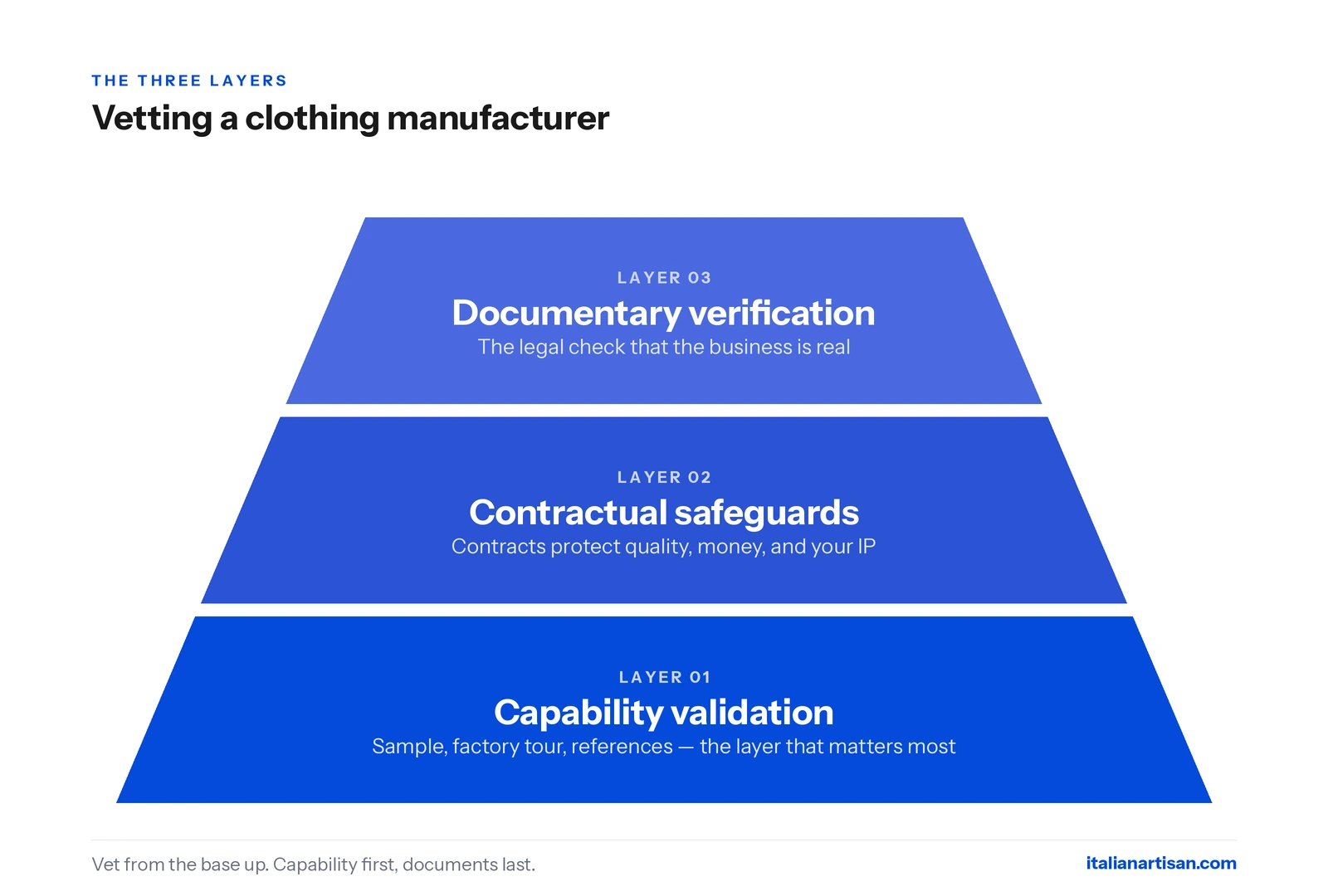
The rest of this guide walks through all three, starting where it matters most.
Why vetting matters more than negotiating price
A low price on a factory that fails you is the most expensive outcome of all. That’s why vetting comes before price: until you know the factory is real and capable, you’re bargaining over a risk you haven’t measured.
Most brands fall into the same trap. They line up quotes and pick the cheapest, before checking whether that factory can deliver at all. Flip the order instead: confirm capability first, then talk price with the ones that pass.
Skipping vetting exposes you to four kinds of risk:
- Financial risk: A deposit on a factory that goes quiet is gone, and upfront-heavy payment terms make the hit bigger.
- IP risk: Share a tech pack with the wrong factory, and your design can resurface under another label.
- Quality risk: A clean sample doesn’t guarantee a clean bulk run. Without checks, quality drifts between the two.
- Delivery risk: Miss the production window and you have no product in season, with the costs already sunk.
The cheapest quote often carries the most of these, which is exactly why it’s the wrong place to start.
Layer 1: Capability validation
Capability validation means proving a factory can actually make your product, in your category, at your quality, before you commit a cent to bulk. It’s the most important layer, and the tools are simple: a sample, a factory tour, and a couple of honest references.
This is the layer most brands rush, and almost every expensive mistake in production traces back to skipping it.
The sample is your real audit
Order a sample before you do anything else. It’s the one test a factory can’t fake with a slick PDF or a confident sales call, and it tells you, in one round:
- Construction quality: Seams, finishing, fit, and how the fabric is handled. The things photos hide.
- Whether they read your spec: Did the sample follow your measurements and details, or did they guess?
- How they communicate: Did they ask questions, flag problems, and propose fixes? Or go quiet and improvise?
- How close they land: How far the first sample sits from your reference tells you how many rounds bulk will take.
- How long it really takes: The actual sampling time, measured against what they promised.
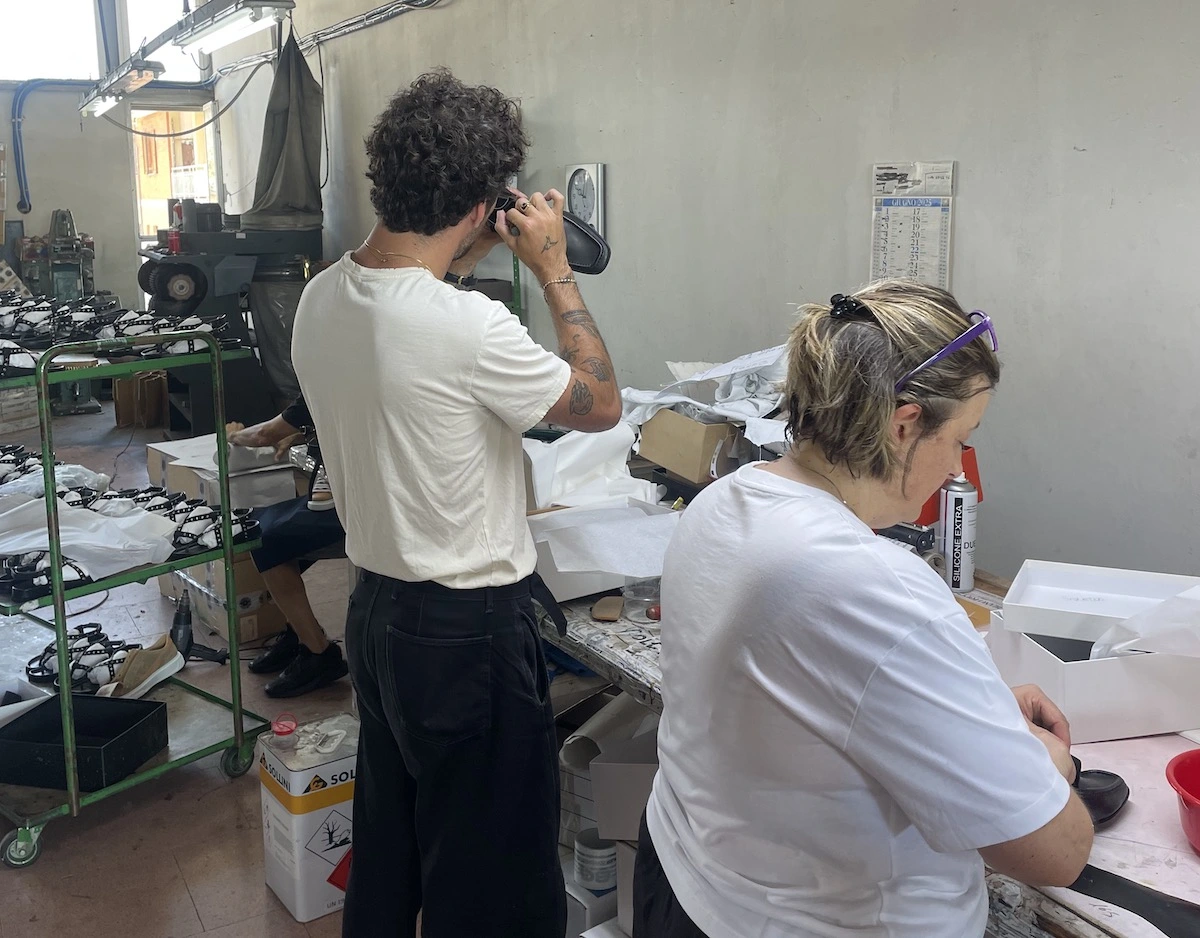
Always pay for the sample. A factory that takes sampling seriously charges for it, while a free sample is often a show piece made better than your bulk will ever be, or a sign of corners cut elsewhere. And read the result as a behavior test, not only a product test: the factory that asks the right questions before sewing is the one that will save you in production.
Sample with two manufacturers at once
The clearest read on capability is comparison, so brief two shortlisted factories on the exact same spec and put their samples side by side.
Let’s say you’re sampling a tailored wool coat. One factory’s sample comes back clean, with two smart questions asked along the way. The other arrives late, with a substituted lining and no note. You didn’t just get two samples, you got your answer.
Yes, it costs two sampling fees instead of one. But the signal is worth far more than the extra fee, and it stops you anchoring on the first factory you happened to try. You see what “good” actually looks like for your product before you commit to anyone.
Don’t over-commit early
Keep your first commitment small: no large bulk order, no season-long exclusivity, until a sample has passed.
The safe bridge from sample to scale is a trial order, a small first production run well below your full season. It proves the factory can hold quality at volume, not just on a single hand-made sample, and that gap is where a lot of factories fall down. The logic is simple: limit what you can lose before you’ve seen the factory deliver real units.
Plan and budget for switching
Here’s the part brands forget. When you test a manufacturer you’ve never used, “we might have to change producer” is a normal scenario, not a worst case.
So build it into the plan. Put buffer in the timeline and the budget for the chance that the first sample fails, you re-sample with someone else, and you restart. Brands that plan for this stay calm when it happens and still hit their season; brands that assume the first factory will work lose weeks they never had.
Tour the factory
Visit if you can. In person is best, a video walkthrough is a solid second, and a trusted person on the ground is a fine third. A tour shows you what a sample can’t:
- In-house or subcontracted: Whether they actually make the product themselves, or quietly pass it to someone else.
- Real capacity: The scale and the machinery, measured against the volume they promised you.
- How they work: The organization, the conditions, and the order on the floor, which you read in minutes.
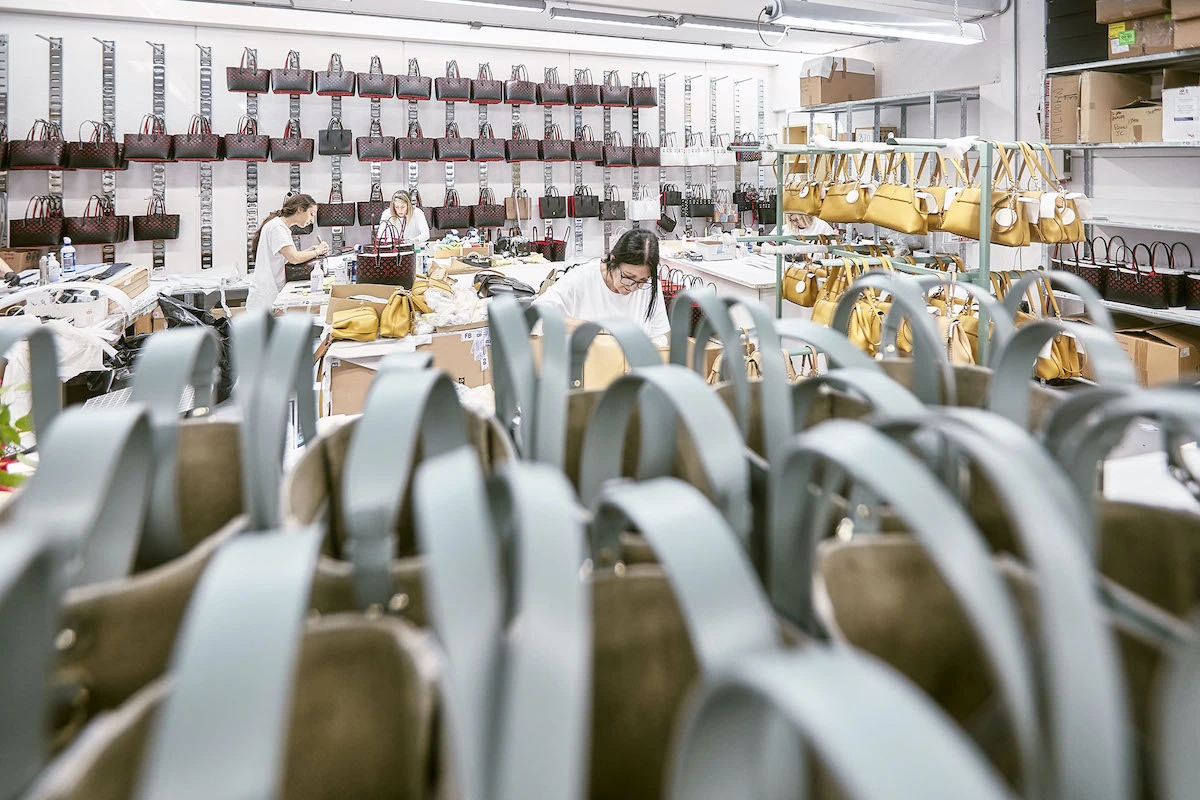
If you genuinely can’t get eyes on the place, treat that as a gap to close another way, not a step to skip.
Check real references
Ask for references, and ask for the right ones: brands like yours, at your size, making something close to your product. Small and independent brands give the most honest feedback, while a big-name client on the list looks impressive but tells you little about how a small order gets treated.
When you reach a reference, ask the questions that matter:
- Did quality hold from sample to bulk? The single most useful thing to know.
- Did they hit the deadlines they set? Not the ones you hoped for. The ones they promised.
- How did they handle a problem? Every production has one, and the response is the real signal.
- Would you order from them again? The simplest question, and often the most telling.
Layer 2: Contractual safeguards
Contractual safeguards are the terms you put in writing before production starts: an NDA, a manufacturing agreement, clear ownership of your patterns, payment milestones, and your right to check the work. They don’t make a bad factory good. They make sure that what a good factory proved in Layer 1 is what you actually get.
Start with an NDA, but know its limits
Most brands lead with an NDA (non-disclosure agreement), and it’s worth doing. Get one signed before you share your full tech pack. It’s quick, it’s cheap, and it signals you’re serious.
But be honest about what it protects. In fashion, the hard part is defining where your intellectual property actually begins and ends. Silhouettes, trends, and common construction techniques are shared ground, so a design dispute is difficult to pin down and an NDA is difficult to enforce on one.
So protect yourself, but stay clear-eyed: an NDA is a baseline, not a solved problem. Signing one is not the same as being protected, and it never replaces a maker you’ve actually vetted.
The manufacturing agreement is the real protection
The NDA protects information; the manufacturing agreement protects the work. This is the document that matters, and at a minimum it covers:
- The approved sample as the standard. Name the signed-off sample as the binding quality benchmark. Bulk that doesn’t match it is non-conforming, full stop.
- What happens with defects. Agree the remedy before production: repair, replacement, or refund, and the window to claim it.
- Timelines, and what happens if they slip. Put delivery dates in writing, and agree the consequence for a missed one.
- Payment milestones. Tie payments to stages, not to one upfront transfer. More on this below.
- Ownership and confidentiality. State plainly that your patterns, tech packs, and designs stay yours.
- Subcontracting approval. Require written sign-off before any part of your order is sent to another workshop.
Make sure you own your patterns and tech pack
Here’s a gap most brands miss: who owns the patterns and the graded size set once they exist? You paid for the product, but the pattern and the size development were built in the workshop, and without a clause ownership gets murky.
Set the default you want. The patterns, the graded specs, and the tech files are yours, handed over on request with no copies kept. Reputable makers agree to this without a fight, so get it in writing before you share the final tech pack, not after.
Get payment terms that protect both sides
Payment terms are where vetting turns into real money at risk. The structure you agree decides what happens if something goes wrong mid-production, and sometimes it does. The safe structure splits payment across stages: a deposit to start, the balance tied to milestones or completion. Avoid paying 100% upfront.
Why it matters, from real cases we’ve handled:
- A producer once went into liquidation in the middle of a run. Because the brand had paid only 50%, recovering the money was far simpler than it would have been at full payment.
- Another time, a brand hit financial trouble mid-production. We paused the work, quantified the materials and labor already spent, and settled around that, because the full sum wasn’t already gone.
A fair deposit protects both sides. The brand isn’t exposed for the whole amount, and the maker isn’t left holding the cost of materials and work if the brand walks away. Pay nothing and the maker carries all the risk; pay everything and you do.
One reality to plan for: overseas, many factories ask for 100% upfront and won’t start without it. If you accept those terms, accept what they mean. You’re taking the risk, so only agree if you can absorb the full loss should the order fail.
Build in visibility, not just an “inspection right”
You’ll see “inspection rights” in most agreements, the right to check the goods before they ship. Keep it in, but know that the clause matters less than the visibility. What actually protects you is seeing the work while it’s happening.
Ask for step-by-step photos at each stage: cutting, assembly, finishing, packing, and video if you can get it. Photos at each step catch a problem while it can still be fixed, where an inspection used only at the end catches it when it’s already too late. If you can be there in person, or send someone, better still.
Protecting your IP in practice
IP protection is the safeguard brands worry about most, so here’s the honest version. On paper, your designs are yours. In practice, chasing an IP claim across borders is slow, costly, and rarely worth it for a small brand. So protect yourself before there’s a dispute, not after:
- Vet the maker first. Trust is your real protection. This is Layer 1 doing its job.
- Share the minimum needed. Give the workshop what it needs to make the product, not your entire proprietary process.
- Put ownership and confidentiality in writing. The NDA and the agreement, working together.
Legal recourse is the backstop, but choosing the right maker is what actually protects you.
Layer 3: Documentary verification
Documentary verification means confirming the factory is a real, registered business, and that you’re paying the entity you actually vetted. It’s the last layer for a reason: necessary, but never enough on its own. A fraudulent factory can have perfect documents, while a legitimate artisan workshop may have never heard of ISO 9001. Paperwork tells you a company exists, not whether it can make your product or whether it’s honest.
What to actually check
Keep this layer simple. A few documents confirm the business is legitimate:
- Tax or VAT ID: A registered tax or VAT number, valid in the factory’s country. The basic proof the business is real and trading.
- Business license or company registration: Confirms the company is legally incorporated, and shows who stands behind it.
- Relevant certifications: Fabric, organic, or social-compliance certificates, but only the ones your product actually needs. Don’t ask for a wall of paper you’ll never use.
Where you can, check the numbers against the public business register in the factory’s country instead of taking a PDF at face value. A document is easy to mock up, but a registry entry is harder to fake.
Read documents for what they are
Documents confirm a business exists. They don’t confirm it can make your product. So treat this layer as a filter for obvious fakes, not as proof you’ve found the right maker.
This matters most with small premium workshops. Many of them do excellent work without a single ISO certificate, simply because certification is expensive and their clients have never asked for it. A missing certificate isn’t a red flag here, and a full folder of them isn’t a guarantee.
So let the documents do their narrow job, and let the sample and the references carry the real decision.
A practical vetting sequence
Run the three layers in order, and stop at the first one a factory fails. That order is the whole point: most of the weeks brands waste come from paying deposits and signing papers before they know the factory can even make the product.
Here’s the sequence, and the quick reference below maps each step back to its layer:
- Shortlist and brief. Send the same tech pack to two or three makers, so you’re comparing like for like.
- Sample your top two, in parallel. Pay for both, and read each one for quality, communication, and fit to your spec.
- Check references and tour the floor. Two honest references from brands like yours, plus a look at the workshop in person or on video.
- Lock the contract. An NDA first, then the manufacturing agreement: approved sample as the standard, milestone payments, pattern ownership, and step-by-step photos.
- Verify the documents. Tax or VAT ID, company registration, and a check that the invoice and bank name match the company you vetted.
- Place a trial order. A small first run before you commit to a full season.
| Layer | What it confirms | Where to start |
|---|---|---|
| 1. Capability | They can make your product, at your quality | A paid sample, two makers in parallel |
| 2. Contracts | The deal is protected if something goes wrong | Approved sample as the standard, milestone payments |
| 3. Documents | The business is real and you’re paying the right entity | Tax or VAT ID, invoice name matches |
The Clothing Manufacturer Vetting Checklist
Every check from this guide on one page, in order. Print it, and take it through your next sourcing round.
Download the checklist (PDF)When to let someone else vet for you
Vetting a clothing manufacturer well takes time, the right questions, and the experience to read a sample for what it really tells you. If you don’t have all three, the smartest move can be to let someone do the vetting for you, before you ever sign.
That’s the gap a managed production partner fills. Instead of running the three layers yourself, you work with a team that has already vetted the workshop, structured the contract, and checked the paperwork, so the due diligence is done before your money is on the table.
This is the role Italian Artisan plays. Every workshop in the network is vetted, across clothing, knitwear, bags, and shoes, and every production gets its own project manager. In practice, that turns the three layers into one relationship:
- Capability is proven before you commit. Workshops are matched to your product and volume, then sampled, so your order lands with a maker that actually fits.
- The contract is already structured. Clear payment terms, pattern ownership, and quality checks are built in, not left for you to negotiate alone.
- The business is verified. You’re working with a real, accountable partner, not a name from a directory you have to check yourself.
It won’t be the right fit for everyone. If you have the contacts and the time, vetting on your own gives you the most control. But if you’d rather skip the months of searching, and the risk of a first sample that never arrives, a partner who has already done the vetting is the faster path to production you can trust.
Produce in Italy with a vetted partner
Tell us what you’re making. We match you with a workshop we’ve already vetted, structure the terms, and manage the production from first sample to delivery.
- Pre-vetted workshops — capability, contracts, and paperwork checked before you commit
- One project manager — on your production end to end, no chasing factories across time zones
- Staged payments — never 100% upfront on production, so your money stays protected
No commitment.
Frequently asked questions
How do you vet a clothing manufacturer before placing an order?
Vet in three layers, in order. First prove capability with a paid sample, a factory tour, and real references. Then put the deal in writing with an NDA, a manufacturing agreement, and milestone payments. Last, verify the business with a tax or VAT ID and company registration. Stop at the first layer a factory fails.
Is an NDA enough to protect my designs?
No. An NDA is worth signing, but on its own it isn’t real protection. In fashion, the hard part is defining where your intellectual property begins and ends, since silhouettes and common techniques are shared ground. Your strongest protection is vetting the maker first and sharing only what they need to produce the order.
What payment terms are safe with a clothing manufacturer?
Split payment across stages: a deposit to start, the balance tied to milestones or completion. Avoid paying 100% upfront, because that leaves you exposed if the order goes wrong. Overseas factories often ask for the full amount before production. Only accept those terms if you could absorb the entire loss.
Should I pay for a sample?
Yes. A factory that takes sampling seriously charges for it, and a paid sample is the single most useful test you can run. A free sample is often a show piece made better than your bulk will be, or a sign of corners cut elsewhere. Treat the sample fee as the cheapest insurance in the whole process.
Do I need a third-party factory audit?
Usually not, for the premium small-workshop end of the market. Formal audits are built for large factories and high volumes, and they tell you little about whether a small maker can deliver your product. A paid sample, a tour, and honest references give you a clearer read for the kind of production this guide covers.
How long does it take to vet a manufacturer properly?
Plan for a few weeks, most of it sampling. A first sample usually takes two to four weeks once the fabric is in, and references and documents can run in parallel. It’s worth the time, since rushing the vetting is what leads to the lost deposits and failed bulk runs it’s meant to prevent.