
Table of contents
2 – Phase one: preparation
3 – Phase two: development
4 – Phase three: production and delivery
5 – Where the process goes wrong
6 – Running the whole process with one partner
7 – Frequently asked questions
TL;DR — Fabric sourcing decides more than how your garment looks. It sets your minimum order, a large share of your cost, and the start date of everything else. The first question is who buys the cloth, you or the workshop. The second is what the mill’s smallest roll is, because that number usually becomes your minimum order quantity. Budget two to five weeks to get materials in hand before production can begin.
Most brands treat fabric as an aesthetic choice: pick the cloth you like, then get it made. In practice, fabric sourcing is the stage that quietly sets the terms for everything downstream.
It decides your minimum order, because the smallest roll a mill will sell often becomes the smallest run you can produce. It drives a large share of your unit cost. And it controls your timeline, because nothing else starts until the material is in the workshop.
So this guide covers how fabric sourcing actually works: who buys the cloth, how mill minimums become your minimums, what to specify, where to find suppliers, and how long it all takes. It’s one stage of the wider clothing manufacturing process, and arguably the one with the longest reach.
First question: who buys the fabric?
Before anything else, settle this. The answer changes your cost, your workload, and your risk, and it defines which kind of workshop you should even be talking to.
There are two common arrangements.
- You supply the fabric. Known as CMT (cut-make-trim) or façon, where the workshop provides labour and you provide the material. You source the cloth, you pay for it, and you carry the risk if it’s wrong.
- The workshop supplies the fabric. Known as full package, where the factory sources materials and quotes you one price per finished garment. Less work for you, less direct control over the cloth.
Neither is better in the abstract. Supplying your own fabric makes sense when you want a specific mill, have an existing relationship, or need control over exactly what goes into the product. Full package makes sense when you’d rather hand the problem to people who buy cloth every week.
What matters is asking early, because the answer carries consequences neither side controls. Here is how a manufacturer in our network explains it to brands:
“Brands often think the minimum is something we decide. It isn’t. When we supply the fabric, the minimum per colour is forty garments, and that number comes from the mill: forty is what the smallest roll gives us. I can’t quote twenty-five, because nobody sells me half a roll. If the brand supplies its own fabric, the arithmetic simply moves to them.”
That is the single most useful thing in this guide, and it points at a mechanism most brands never see.
How the mill’s minimum becomes your minimum
Here’s the chain almost nobody explains. Your minimum order quantity rarely starts at the factory. It starts one step further up, at the mill that sells the cloth.
Mills sell fabric in rolls, and a roll is a fixed quantity. If the smallest roll a mill will sell yields enough cloth for forty garments, then forty garments is the floor, whoever buys it. The workshop isn’t inventing a number to keep small brands out. It’s passing along the constraint it received.
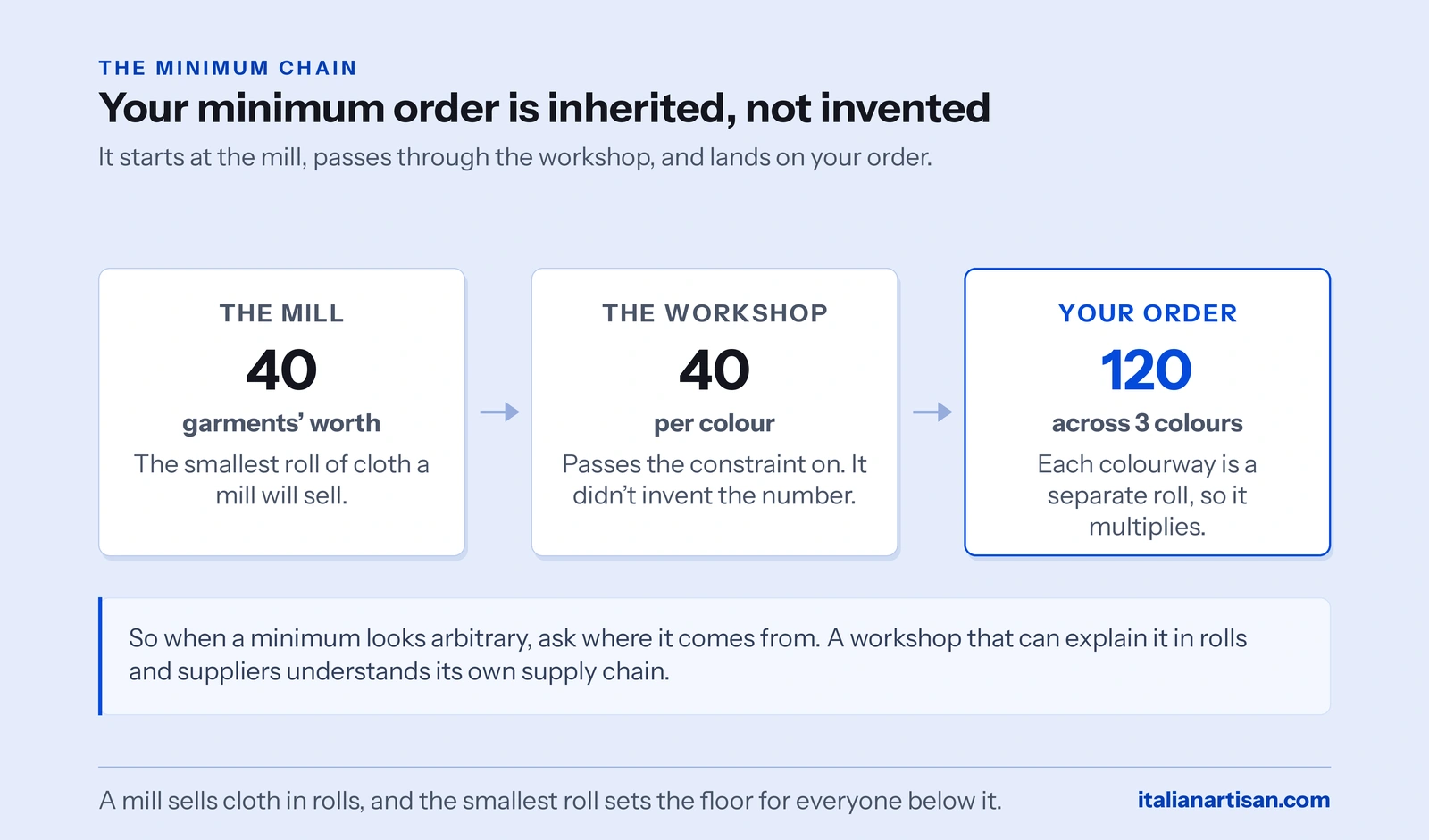
This is also why minimums are quoted per colour rather than per style. Each colourway is a separate roll, so three colours can mean three separate minimums, and a 40-piece minimum quietly becomes 120 pieces across your range.
The effect gets sharper with specialist materials, where the quantities involved can dwarf your order:
“This is the part brands don’t expect. The moment you ask for a material nobody keeps in stock, someone has to order it, and that supplier has a minimum of its own. If that minimum is five hundred metres of leather, then five hundred metres is what gets bought, and you are paying for all of it before you have seen a single prototype. It is not the price per metre that hurts. It is committing the whole amount before you know the product works.”
Which makes an unusual material a cash decision long before it is a design one.
There is a practical way around it at the prototype stage, and it’s worth knowing. Workshops usually build first prototypes from materials already in their stock, so you can see and handle the product without triggering any material order at all. The full quantity only becomes necessary when you commit to production.
So when a minimum looks arbitrary, ask where it comes from. A workshop that can explain the number in terms of rolls and suppliers is telling you it understands its own supply chain. One that can’t explain it is worth a second look.
What to specify when you source fabric
“Cotton” is not a fabric specification. It names a fibre, and says nothing about how the cloth will behave, hang, or wear. Two cottons can produce two completely different garments.
A workable specification covers four things.
- Composition: the fibres and their percentages. 100% cotton, or a blend like 70% wool and 30% silk, each behaving differently.
- Weight: measured in grams per square metre (gsm), and the fastest way to separate a summer shirting from a winter one. Weight changes drape, structure, and how the garment feels on.
- Weave or knit structure: twill, poplin, jersey, gabardine. The construction decides stretch, durability, and how the cloth takes a crease.
- Finish: what was done to the cloth after weaving. Brushed, mercerised, water-repellent, garment-dyed. Finishing can change the hand of a fabric more than the fibre does.
Get as close to an exact reference as you can. Mills identify their cloths by article name and colour code, and quoting that reference removes all ambiguity. A fabric line on a real tech pack looks like this:
“Art: Gabardina Verona Colore 01”
That names a specific cloth, in a specific colour, from a specific mill. Nobody has to guess, and the wrong fabric can’t arrive by accident.
If you can’t reach that level of precision yet, work with what you have. A physical swatch is the strongest substitute, because it settles weight and hand instantly. Failing that, send a garment whose fabric behaves the way you want yours to, and let the workshop match it.
Don’t forget the trims
Fabric gets the attention, but trims follow the same logic and carry the same minimums. Zips, buttons, hardware, woven labels, and thread all come from suppliers with their own lot sizes and lead times.
A custom-branded zip or a specific hardware finish can carry a minimum order of its own, and it can be the thing that holds up an otherwise ready production. Specify trims at the same time as the cloth, not after the fabric is settled.
Some fabrics carry more risk than others
Not all cloth is equally straightforward to work with, and knowing this in advance saves sampling rounds. Delicate, heavily embellished, or unstable fabrics take more skill to cut and sew, and they behave less predictably in production.
A brand owner we worked with met this on a jacket project:
“I was told early on that sequin is a difficult fabric to work with, and risky. I’m glad I heard it before we started rather than after. It doesn’t behave like a plain cloth when you cut it or sew it, so you plan for more rounds and you accept it will take longer. Knowing that in advance changed how I budgeted the whole project.”
So the answer isn’t to avoid difficult fabrics, since plenty of beautiful products depend on them. It’s to ask the question early, and to choose a workshop that has handled that material before.
The Fabric Specification Sheet
A one-page form to fill in and send to a mill or a workshop: the four things that define a cloth, your quantities, and the five questions to ask before you commit.
Download the spec sheet (PDF)Where to find fabric suppliers
Fabric is one of the few things in this business that still rewards showing up in person. You can research a mill online, but you can’t feel the cloth through a screen, and hand is most of what you’re buying.
Trade fairs are the fastest route
If you want to cover a lot of ground quickly, the fabric fairs are hard to beat. A few days in a hall puts hundreds of mills within walking distance, with swatches you can handle and people you can ask directly about minimums and lead times.
Three are worth planning around.
- Lineapelle: the essential one for leather. Tanneries, hides, and the accessories and components that go with them.
- Milano Unica: the reference fair for Italian textiles, and the most efficient way to see the high end of Italian and European mills in one place.
- Première Vision: broader and more international, with a consistently strong fabric area.
Go with your specification in hand and a clear idea of your quantities. The first question a mill will ask is how much you need, and having a real answer is what turns a pleasant conversation into a quotation.
Through your manufacturer
The other route is simply to use the relationships your workshop already has. A manufacturer who has produced your kind of garment for years knows which mills deliver on time, which hold stock, and which will accept a smaller order.
That access is worth more than it sounds, as a tailor in our network describes:
“After years of working the same way, you stop searching for fabric and start choosing it. I hold selections from most of the mills a client would name: Vitale Barberis Canonico, Zegna, Loro Piana, Drago, Carnet. A brand arriving on its own would have to open an account with each of them, and at a first small order most wouldn’t bother. Through us, they just pick the cloth.”
Italy’s depth here is concentrated by district. Biella is the centre for wool, with Vitale Barberis Canonico, Zegna, and Drago among the mills based there. Como is the historic silk district, home to houses like Mantero. Prato is known for recycled and woollen fabrics.
Stock service versus made-to-order cloth
One distinction that decides your timeline more than any other. Some fabrics sit in stock, ready to ship. Others are woven to order once you commit.
Stock service fabric can reach the workshop in days and often carries lower minimums, because the mill is selling from inventory. Made-to-order cloth gives you exactly what you want, including custom colours, but you wait for it to be produced and you commit to a full production run of the material.
If your timeline is tight, ask what’s available from stock before falling in love with something that has to be woven. It’s the single easiest way to take weeks out of a schedule.
How long fabric sourcing takes
This is the stage brands leave out of the plan, and it’s the one that most often pushes a launch date. Production time gets quoted and remembered. Material time happens first and gets forgotten.
The working figures look like this.
| Step | Typical time | What decides it |
|---|---|---|
| Getting swatches to review | Days to two weeks | Whether the mill holds a swatch library, and where you are |
| Ordering materials | 2–5 weeks | Stock service is fast; woven-to-order is not |
| Sample development, once fabric arrives | About 15 days | Counted from receipt of the cloth, not from the order |
That middle row is the one to plan around. Two to five weeks to get materials in hand, before the workshop can begin, is normal rather than exceptional, and it sits ahead of everything else in the schedule.
The last row carries a detail worth repeating. When a supplier commits to fifteen days for a sample, the clock starts when the fabric is in the building. Order the cloth late and you don’t just lose the ordering weeks, you delay the start of every stage that follows.
So work backwards from your launch date, and put materials first in the plan. It’s the cheapest scheduling decision you’ll make.
Getting help with sourcing
Sourcing fabric well takes three things most brands don’t have at the start: knowing which mills to approach, enough volume to be interesting to them, and the experience to judge a cloth from a swatch.
That’s the practical case for sourcing through a production partner rather than alone. An established network reaches mills that wouldn’t open an account for a first order, consolidates smaller quantities, and knows which suppliers hold stock when a deadline is tight.
It also puts fabric decisions next to production decisions, where they belong. Choosing a cloth that a particular workshop struggles to sew is a problem you only avoid when the same people handle both ends of the question.
That’s how production in Italy works with us: fabric sourcing, development, and manufacturing handled as one chain rather than three separate problems.
Find the right fabric, and the workshop that can sew it
Tell us what you’re making, the hand and weight you’re after, and your quantities. We’ll source options from Italian mills and match you with a workshop that works in that material.
- Access to Italian mills — wool from Biella, silk from Como, and the specialists in between
- Workable minimums — we’ll tell you what the real floor is for your fabric, and why
- Prototypes from stock — see the product before committing to a full material order
Frequently asked questions
Should I supply the fabric or let the manufacturer source it?
It depends on how much control you want and how much work you can absorb. Supplying it yourself, known as CMT, suits brands with a specific mill in mind or an existing relationship. Full package, where the workshop sources materials, means less work and a single price per garment, but less direct control over the cloth.
Why is the minimum order per colour rather than per style?
Because each colourway is a separate roll of fabric. A mill sells cloth in rolls, and the smallest roll sets the floor, so ordering three colours usually means meeting the minimum three times. A 40-piece minimum across three colours becomes 120 pieces.
How long does it take to get fabric?
Two to five weeks is typical to get materials in hand, and it sits ahead of everything else in the schedule. Fabric held in stock can arrive within days, while cloth woven to order takes considerably longer. Sample development then runs about fifteen days from the moment the fabric arrives.
What information does a mill need from me?
Composition, weight in grams per square metre, weave or knit structure, and finish, plus your quantity. If you know the exact article name and colour code, quote it, because that removes all ambiguity. If you don’t, a physical swatch or a reference garment works well.
Do I have to buy all the fabric before seeing a prototype?
Usually not. Workshops typically build first prototypes from materials already in their stock, so you can see and handle the product without triggering a material order. The full quantity becomes necessary when you commit to production, which is when minimums apply.
Where can I find fabric suppliers?
Trade fairs are the fastest route: Lineapelle for leather, Milano Unica for Italian textiles, and Première Vision for a broader international range. The other option is to use your manufacturer’s existing relationships, which often reach mills that wouldn’t open an account for a first small order.