
Table of contents
2 – Red flags in the first contact
3 – Red flags during sampling
4 – Red flags in pricing and payment
5 – Red flags in communication
6 – Red flags in the paperwork
7 – Red flags that aren’t really red flags
8 – When the red flags add up
9 – Frequently asked questions
TL;DR — A red flag is a warning sign that a clothing manufacturer will likely cost you money, time, or your design. The clearest ones show up phase by phase: in the first contact, during sampling, around pricing and payment, in how they communicate, and in their paperwork. One flag is a question worth asking. A cluster of them is your answer. And a few “red flags” you’ll read about online aren’t red flags at all for premium, small-batch production.
Most manufacturing relationships don’t fail suddenly at the end. The warning signs show up much earlier, in the first emails, the first quote, the first sample. And brands rarely lose money because they missed a sign. They lose money because they noticed one and decided it wasn’t serious.
So this is a guide to the clothing manufacturer red flags that matter, and where each one tends to appear. Not a scare list. A practical map of what to watch for before you send a deposit or a tech pack (the technical document that tells the factory how to make your product).
If you’re choosing between makers right now, pair this with our guide on how to find a clothing manufacturer. And if you’d rather work with a clothing manufacturer that’s already been vetted, we’ll come back to that at the end.
One thing to hold onto as you read. A single red flag rarely means walk away. It means look closer. The danger is in the pattern, not the one-off.
What counts as a red flag?
A red flag is a warning sign that a clothing manufacturer is likely to cost you money, quality, or time. It’s not proof of a bad factory. It’s a signal to slow down and look closer before you commit.
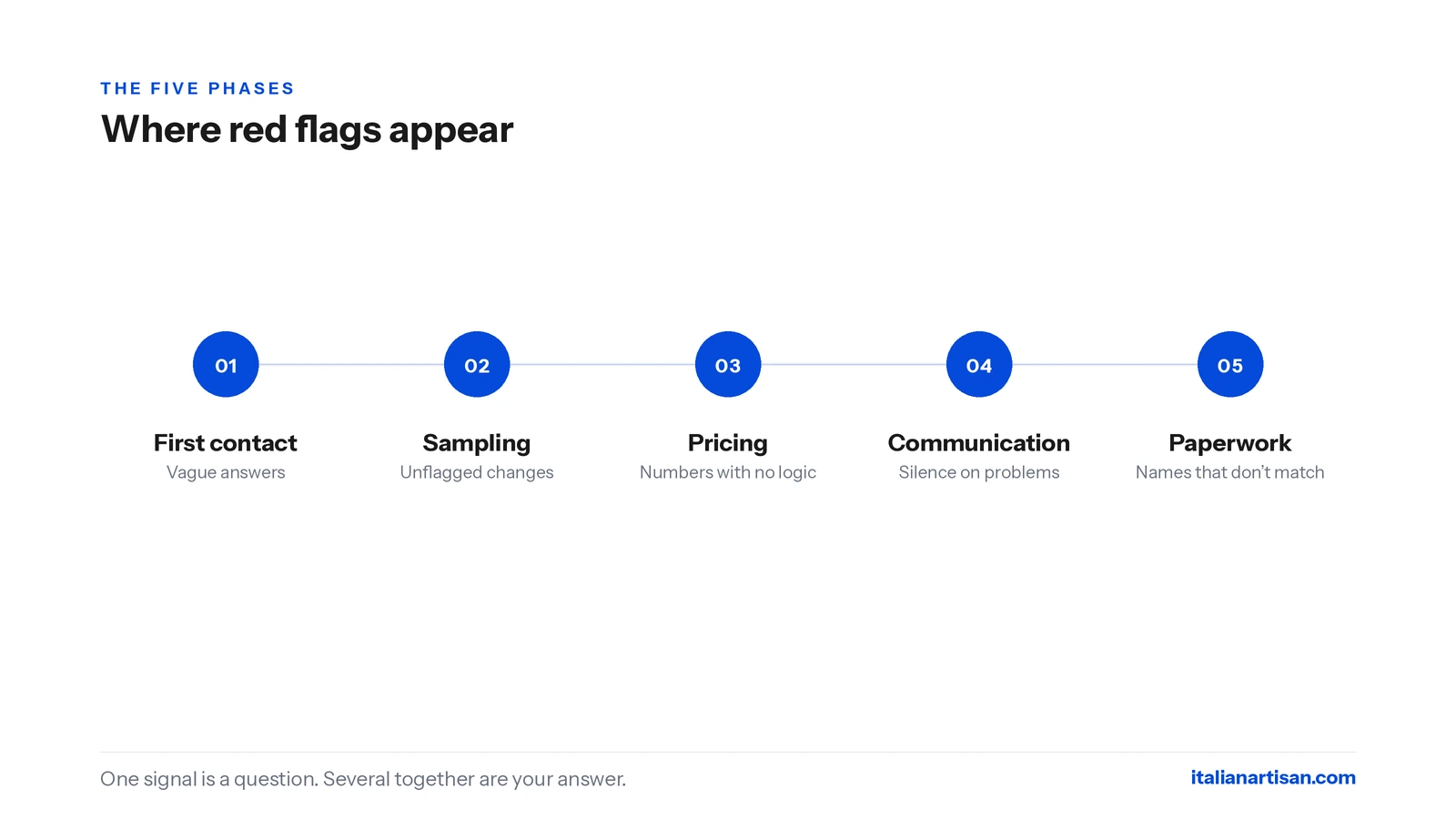
The useful thing about red flags is that they’re predictable. They tend to surface at the same five points, in the same order, as you move from first email to finished sample. Knowing where to look means you catch them early, while you can still walk away cheaply.
Here are the five phases where they appear:
- First contact: How they answer your opening questions about how they work, what they cost, and what they can make.
- Sampling: Whether the sample matches your brief, and how they handle your corrections.
- Pricing and payment: How the numbers are built, and what they ask for upfront.
- Communication: How they respond when things are unclear, or when there’s a problem.
- Paperwork: Whether the business behind the workshop is real and checks out.
We’ll walk through each phase in turn. Then we’ll cover the signals that look like red flags but usually aren’t, especially for premium, small-batch production.
Keep the rule from the top in mind. You’re looking for a pattern, not a single slip.
Red flags in the first contact
The first exchange tells you more than most brands expect. Before anyone has made anything, you can already read how a manufacturer thinks about production, and how they’ll treat you when something goes wrong.
What you’re testing here is specificity. A serious workshop answers narrow questions with narrow answers, while a weak one answers everything with the same brochure.
They can’t explain how they work
Ask early whether they work in CMT (cut-make-trim, where you supply the fabric) or full package (where the factory sources the fabric and trims for you). It’s a basic question, and the answer shapes your budget, your timeline, and how much of the sourcing lands on your desk.
A manufacturer who can’t answer clearly, or who says “both, whatever you prefer” without explaining what changes, is telling you something. In our experience, a producer who can’t articulate that difference rarely works with serious brands.
The good version sounds concrete. They tell you which model they run, what they need from you in each case, and where their limits are.
The MOQ comes with no explanation
MOQ (minimum order quantity, the smallest run a factory will accept) is where a lot of brands get spooked for the wrong reason. A high MOQ isn’t the red flag. Not being able to explain it is.
A real workshop can trace the number back to something physical:
- The fabric roll: Their mill won’t cut below a minimum length, which sets the floor per color.
- The hardware lot: Zips, buttons, and trims come in minimum batches from their own suppliers.
- Setup cost: Cutting, marking, and machine setup cost roughly the same for 20 pieces as for 200.
One producer we work with puts it plainly: the minimum per color is 40 garments, because that’s the smallest roll the mill will sell. That’s a good answer. It’s specific, and you can plan around it.
The dangerous version is silence. Your chosen material may carry a minimum you’d have to pay for in full before you see a single prototype, and if nobody says so, you find out when the sample arrives in a substituted color or fabric. A manufacturer who lets you discover that at sampling stage isn’t protecting you.
Their answers don’t answer your questions
Send five specific questions and count how many come back answered. Three out of five is a signal, not an accident.
Three things are worth noticing here. They send a generic company presentation instead of answering what you asked. They repeat your question back in different words, without actually answering it. Or they say yes to a technique without asking you a single detail about it.
This matters because first contact is their best behavior. If the answers are thin now, while they’re trying to win your order, they won’t get thicker once they have it.
Red flags during sampling
Sampling is where a manufacturer stops describing their work and starts showing it. It’s also where the most expensive signals appear, because a problem you miss on one sample becomes a problem you pay for across a whole production run.
You’re reading two things at once here. The sample itself, and the behavior that produced it.
The sample drifts from your tech pack
It’s normal to get a first sample with deviations. Nobody hits every spec on the first attempt, and a workshop that promises otherwise is overselling.
The red flag isn’t the deviation. It’s the deviation nobody told you about.
So check the sample against your spec, line by line:
- Measurements: Against your graded size chart, not against how it looks on the table.
- Materials: The fabric, lining, and hardware you specified, or something quietly substituted in their place.
- Construction: Seam types, stitch density, and the details your tech pack called out.
- Finishing: Threads, pressing, and labels. The parts a factory cuts when it’s rushing.
A good workshop flags its own changes before you find them. They tell you the fabric wasn’t available, or the hardware wouldn’t hold, and they explain what they did instead. A producer who swaps something and waits to see whether you notice has just shown you how the bulk run will go.
They don’t listen to your brief
This one looks different from drift. The sample isn’t sloppy, it’s just not yours. The maker has strong opinions, and somewhere along the way their taste replaced your brief.
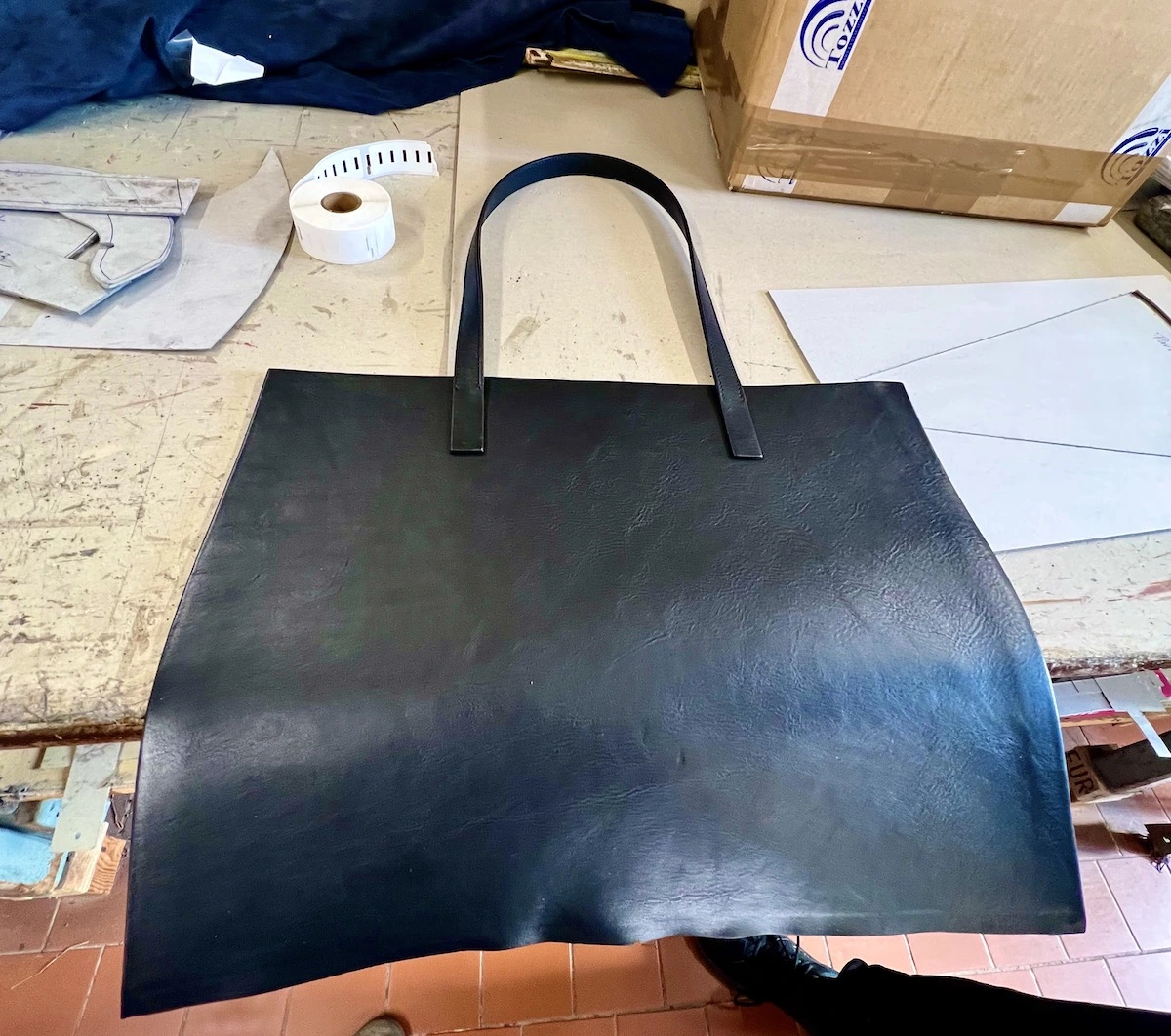
“We had a producer making a leather travel bag who kept pushing his own choices over the client’s. Zamak hardware instead of brass, foil printing on hammered leather. He was insistent, and he didn’t seem interested in the brand’s identity, only in his own vision. The prototype came back far from what the client needed, and we had to change producer.”
The lesson isn’t about skill. A producer can be genuinely good and still be the wrong partner, if what they want to build outranks what you asked for. And a maker who overrides you on a single prototype will override you on three hundred units.
The same defects keep coming back
One flawed sample is information. Two flawed samples with the same flaws is a verdict.
The second round is the real test, because it separates a workshop that was careless from a workshop that can’t do the work. Carelessness can be fixed with clearer comments. The other thing can’t be fixed at all.
“Quality and communication go together. The problems start with a producer who says yes to everything, and then the sample comes back with crooked seams, imprecise printing, threads left uncut, and buttons sewn badly. That producer apologized and offered a second prototype for free. It still came back with defects in the seams and the buttons.”
Notice where the signal actually starts. The defects are the proof, but the yes to everything came first. A producer who agrees to every request, without ever pushing back or asking a question, usually isn’t reading the work closely enough to see the problems in it.
Red flags in pricing and payment
Money is where a manufacturing relationship gets real, and where the signals get easier to read. What you’re watching isn’t the size of the numbers. It’s whether anyone can explain them.
They want everything upfront, and can’t explain why
Asking for a deposit isn’t a red flag. A workshop buys your fabric and reserves capacity before it earns anything, so a fair deposit protects them as much as it protects you.
The signal is a producer who wants the full amount before a machine moves, and treats the question as an insult. In some markets, full payment upfront is simply how it’s done, and that’s worth knowing rather than fearing. But a maker who can’t say what the money is for, and won’t discuss structure at all, is asking you to carry every risk in the relationship alone.
Ask what the payment covers and when the balance falls due. A serious workshop answers in a sentence.
The price sits far below everyone else’s
Send the same tech pack to three makers and the quotes usually land within a reasonable band. When one comes in dramatically under the others, something is different, and it’s rarely generosity.
Normally it’s one of these:
- They read a different spec: A lighter fabric, a simpler construction, or a detail they’ve quietly designed out.
- They’re subcontracting: The work is going somewhere cheaper, and you won’t know where.
- They’re pricing low to win the job: The first run is priced below cost, and the number goes up once you’ve committed.
A cheaper quote can be perfectly legitimate. The difference is that a legitimate one comes with a reason attached: they own their cutting room, they hold that fabric in stock, they’re filling a gap in their calendar. Ask, and see whether the answer is concrete.
Nobody can tell you what the deposit covers
Ask a simple question. If the sample fails, or you cancel before production starts, what happens to the money already paid?
A workshop that has done this before answers without hesitating, because they’ve had the conversation many times. Vagueness here means one of two things: they haven’t thought it through, or they’d rather you didn’t either.
Watch for numbers that move, too. A quote that shifts after you’ve committed, or costs that appear late without a reason attached, tells you how the rest of the project will be priced.
Red flags in communication
By now you’ve seen how a manufacturer answers questions and how they handle a sample. What’s left is the pattern over time, and it’s the most reliable predictor you have. Every production problem starts as something somebody has to tell you about.
They go quiet at the wrong moments
Everyone is slow sometimes. What matters is when. Fast before the deposit and slow after it, responsive about new work and silent about problems: that’s not a scheduling issue, that’s a pattern.
The real test is what happens when something goes wrong. A workshop worth keeping tells you about a delay before you notice it, and usually proposes a fix in the same message. A weaker one waits for you to chase, and by then the delay has grown.
So pay attention to silence that lands on bad news. It rarely stays a communication problem for long.
They never ask you questions
Every tech pack has gaps. There’s always a measurement that reads two ways, a finish nobody specified, or a detail that quietly contradicts another one.
A maker who reads your pack properly comes back with questions. Which seam takes priority. Whether the grading holds at the largest size. What to do if a trim is out of stock.
No questions at all is a quiet warning. It means either they haven’t read it closely, or they intend to fill the gaps with their own assumptions. You’ll see the result in the sample, and by then it has already cost you a round.
Nothing gets put in writing
Some workshops run entirely on calls. Dates, prices, and changes all get agreed verbally, and nothing lands in your inbox afterwards.
That isn’t dishonesty by default, and plenty of small makers simply work that way. But it leaves no shared record, so when two people remember a deadline differently there’s nothing to check it against.
Ask for confirmation in writing after each decision, then watch what comes back. A producer used to working with brands does this unprompted, because the record protects them too. One who avoids it, or answers a written question with another phone call, is leaving the terms vague on purpose.
Red flags in the paperwork
Documents are the last place to look, not the first, because a convincing folder proves very little about whether a workshop can actually make your product. Two paperwork signals are still worth taking seriously.
The first is refusal. A legitimate business shares its tax or VAT number and its company registration without friction, because it does the same with every client. Reluctance, delay, or an excuse is itself the answer.
The second is a mismatch. If the company on the invoice isn’t the company you’ve been dealing with, or the bank account sits in a different name or a different country, stop and confirm who you’re actually paying. That’s the point where a bad situation turns into an unrecoverable one.
Beyond those two, keep your expectations proportionate. Certificates are worth checking when your product genuinely needs them, and worth ignoring when it doesn’t. Which brings us to the signals that get treated as red flags but usually aren’t.
Red flags that aren’t really red flags
Plenty of advice online treats normal workshop behavior as a warning sign. For premium, small-batch production, several of the most-repeated red flags are simply how good makers operate.
Here’s what usually doesn’t need to worry you:
- No ISO certificate: Certification costs money and takes time, and a small workshop with a stable client list has rarely needed one. Judge the work, not the folder.
- They charge for the sample: A paid sample means your prototype is treated as real work and priced as such. A free one is more often a sales tool than a fair test of what your bulk will look like.
- A small operation with a dated website: Many of the best workshops have never needed to market themselves, because word of mouth fills their calendar. A weak website says nothing about a strong cutting room.
- Imperfect English: What matters is whether technical detail survives the conversation. A workshop with one person who can discuss a spec precisely is fine. A fluent salesperson who can’t answer a construction question isn’t.
- A long lead time: A maker who quotes twelve weeks while others promise six may simply be the one telling you the truth about their calendar.
- They say no to part of your project: A workshop that declines a technique it doesn’t do well is protecting you from a bad result. That’s the opposite of a warning sign.
The common thread is that none of these tells you anything about the work itself. Real red flags show up in behavior and output: what the sample looks like, what gets explained, what gets confirmed in writing, and what happens when something goes wrong.
So when a signal worries you, ask one question. Does this tell me something about how they’ll make my product, or only about how they present themselves?
When the red flags add up
Red flags are easy to recognize in hindsight and hard to act on in the moment. That gap is where most bad partnerships actually happen.
Part of it is money already spent. Once you’ve paid for a sample and lost three weeks, a missed deadline starts to look forgivable, and you end up making excuses for them. The rest of it is having nothing to compare against. With one manufacturer in front of you, a slow reply is just a slow reply. With three, the pattern is obvious.
So the practical answer isn’t a longer list of warning signs. It’s context. Someone who has watched a lot of workshops behave over time can tell the difference between a producer having a bad week and a producer who is about to cost you a season.
That’s the role Italian Artisan plays. Every workshop in the network has already been through this filter, across clothing, knitwear, bags, and shoes, and every production gets a project manager who reads the samples and the silences on your behalf. The producers described in this article don’t last long in a managed network.
That doesn’t take your judgment out of the process. It means the first warning sign you meet isn’t yours alone to interpret.
Produce in Italy without reading the signals alone
Tell us what you’re making. We match you with a workshop that has already been filtered, and put a project manager on your production who catches problems while they’re still small.
- Workshops already filtered — makers who behave this way don’t stay in the network
- Someone reading the signals with you — a project manager on the sample, the timeline, and the silences
- Problems caught early — step-by-step visibility instead of a surprise at delivery
Frequently asked questions
What are the biggest red flags when choosing a clothing manufacturer?
The clearest ones are a sample that drifts from your tech pack with no explanation, a producer who can’t explain their MOQ or their pricing, silence whenever there’s a problem, and an invoice from a company you haven’t been dealing with. Any one of these is a reason to ask more questions. Several together is your answer.
Is a high MOQ a red flag?
No. A high MOQ usually reflects the workshop’s own minimums: the smallest roll the mill will sell, the minimum trim lot, the cost of setting up a cut. The red flag is a producer who can’t tell you where the number comes from.
Is it a red flag if a manufacturer asks for full payment upfront?
Not automatically, since in some markets it’s standard practice. It becomes a warning sign when they can’t say what the money covers, won’t discuss any staged structure, and treat the question as an insult. Only accept those terms if you could absorb the full loss.
Should I worry if a manufacturer has no ISO certification?
Usually not, for premium small-batch production. Certification is expensive, and many excellent workshops have never needed one to keep their clients. Judge them on the sample, the references, and how they communicate instead.
How can I tell if a clothing manufacturer is a scam?
The strongest signals are documentary and financial: refusing to share a tax or VAT number, an invoice from a company you’ve never dealt with, or a bank account in a different name or country. Check those numbers against the public business register before any money moves. A genuine business shares them without friction.
What’s the most common red flag brands miss?
A producer who agrees to everything. It reads as good service, but a maker who never pushes back or asks a question usually hasn’t looked at the work closely enough to see its problems. The ones who question your tech pack are generally the ones who can build it.