Table of contents
2 – Prototype or sample clothing?
3 – Finding the right prototype clothing manufacturer
4 – Steps to Start a Private Label Clothing Line
5 – Conclusion
TL;DR — A clothing prototype is the first physical version of your garment, built to test the design before anyone commits to production. Expect two to five weeks for the first one, longer for structured products, and expect more than one round. A prototype usually costs two to three times a production unit, because it carries all the setup and none of the scale. Its job is not to be perfect. Its job is to make your mistakes cheap.
Every brand wants the first clothing prototype to arrive finished, wearable, and exactly right. It rarely does, and treating that as a failure is the most expensive misunderstanding in product development.
A prototype is an instrument. It exists so you can hold the product, see what the drawing couldn’t show, and change your mind while changing your mind is still cheap. A correction at prototype stage costs one round of work. The same correction found in a finished production run costs the run.
This guide covers what a prototype actually is, how long it takes, what it costs and why, and how to give feedback that gets you to a second version worth approving. It’s one stage of how clothing production works, and if you want a partner to run it with you, that’s what Italian clothing manufacturing with us looks like.
Prototype or sample? They are not the same thing
These two words get used interchangeably, and the confusion causes real problems in quotes and timelines. They describe different stages, in this order.
- The prototype comes first. It’s a single physical piece, usually in one size, built to test the design: construction, fit, proportions, and whether the thing can be made at all. It often uses materials the workshop already holds, rather than your final fabric.
- The sample comes after. Once the prototype is approved, sampling develops the product in your real materials, across the sizes and colours you plan to sell. It’s the reference for production.
So a prototype answers “does this work?” A sample answers “is this exactly what we will produce?”
The practical consequence is about money and time. A prototype is a development cost you accept in order to learn something. A sample is closer to a production piece, and you approve it knowing the run will copy it. Asking a workshop for “a sample” when you mean a first prototype usually gets you a longer timeline and a higher quote than you expected.
What the prototype is actually for
A prototype earns its cost by answering questions that only a physical object can answer. Four of them matter most.
- It turns a drawing into three dimensions. Proportions that look right on paper often read differently once the garment has volume, and a collar or a pocket can change character entirely between the sketch and the body.
- It tests fit and comfort. Not just the measurements, but how the garment moves: whether the armhole binds, whether the shoulder sits, whether the wearer can actually raise an arm.
- It exposes construction problems. Some designs can’t be built as drawn, and the fastest way to find out is to try. A workshop will hit the problem on the table and tell you.
- It moves cost forward, where cost is small. Every problem caught here is a correction. The same problem caught in production is a run.

That last one is the whole economic case. Brands often treat prototyping as an expense to minimise, when it’s the stage that protects the much larger sum committed later.
What happens during prototyping
Between approving a quote and holding a garment, the workshop runs through a sequence. Knowing it helps you understand where your input is needed and where waiting is normal.
- The specs get read and questioned. The workshop reviews your tech pack or brief and comes back on anything unclear or unbuildable. Answer quickly here; this is where a week gets lost or saved.
- The pattern gets made. Someone builds the flat shapes the garment is cut from, usually in one size.
- Materials get selected. For a first prototype, often from what the workshop already holds, so you see the product without ordering a full roll.
- The piece gets cut and sewn. The part everyone pictures, and rarely the longest.
- It gets checked, then sent to you. The workshop reviews its own work against your specs before it goes out.
- You review and feed back. Then, in most cases, a second round closes the gap.
Two of those six steps belong to you, and they’re the two that most often set the pace: answering the workshop’s questions at the start, and giving clear feedback at the end.
How long a clothing prototype takes
Two to five weeks for the first prototype, depending on how complex the product is and whether the workshop has to develop anything new to build it.
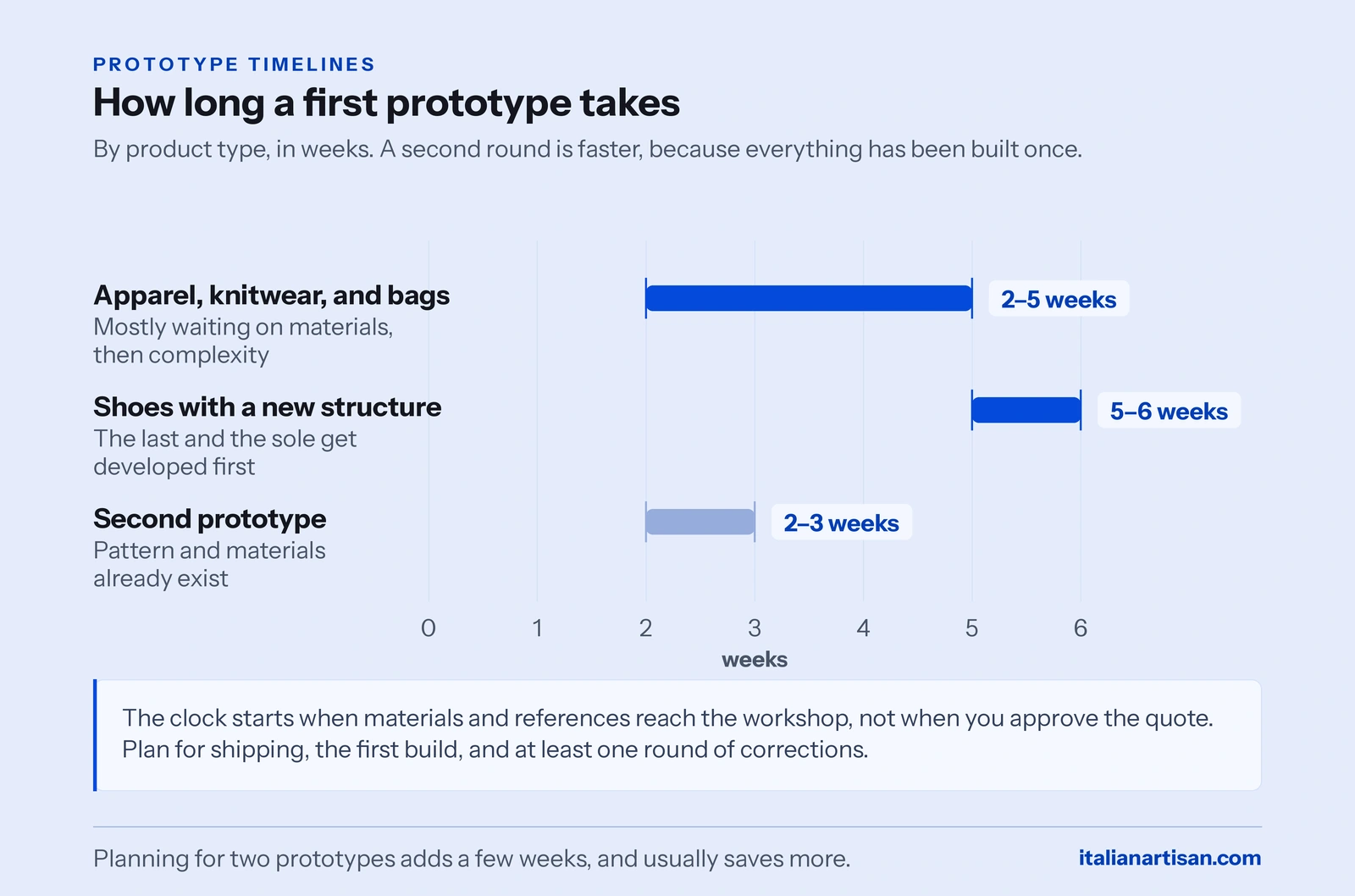
Most products sit in the same window. What moves you to the top of it is complexity: a simple garment or a clean bag shape lands early, a structured piece with many components lands late.
| Product | First prototype | What drives it |
|---|---|---|
| Apparel, knitwear, and bags | 2–5 weeks | Material availability first, then how complex the build is |
| Shoes with a new structure | 5–6 weeks | The last and the sole have to be developed first |
| Second prototype, after feedback | 2–3 weeks | The workshop already has the pattern and the materials |
Notice the last row. The second round is faster than the first, because everything has already been built once. Which means planning for two prototypes doesn’t double your timeline. It adds a few weeks, and it usually saves more than that later.
The longest timelines happen when the workshop has to create something that doesn’t exist yet, rather than assemble something it knows how to make:
“It can take up to five or six weeks to develop the first prototype when the supplier has to develop the structure itself. That’s not the workshop being slow. Before anyone can sew or assemble, someone has to build the thing that makes the shape possible. And to the client it feels even longer than it is, because the waiting starts earlier, with the parcel of materials and references travelling before the work can even begin.”
That last point is the one brands underestimate. The clock rarely starts when you approve the quote. It starts when the materials and references are physically in the workshop, and shipping them takes the time it takes.
So when you plan, count three things, not one: getting materials and references to the workshop, building the first prototype, and at least one round of corrections. Anything faster is a bonus, not a plan.
What a clothing prototype costs, and why it costs more
Here is the number that surprises almost every brand: a prototype usually costs two to three times the production price of the same item. Not a fraction of it.
The logic is simple once you see it. Production spreads setup across hundreds of pieces. A prototype carries all of that setup and divides it by one. Someone develops the pattern, prepares the machines, cuts and builds a single unit by hand, and checks it. There is no volume to absorb any of that work.
Then, for some products, there are one-off costs on top, and these catch people out because they have nothing to do with the garment itself.
- Tooling and moulds. For shoes, developing the last, the wooden or plastic form the shoe is built around, runs around 385 euros. Developing a sole with a dedicated sole factory adds around 250 euros.
- Machine setup. Looms, knitting programmes, and machine configuration all take time to prepare before a single piece exists.
- Hardware and component samples. Custom buckles, rings, and trims often have to be made or ordered separately.
A real example makes the shape of it clear. On a custom pumps project, the prototype cost 1,100 euros in total: 900 for the heels, which had to be developed, and 200 for strap samples with rhinestone work. Most of that figure is not sewing. It’s creating the components that didn’t exist before.
Workshops do have ways to hold the cost down, and it’s worth knowing about them. A common one is building the prototype in cheaper materials than the final product: zamak alloy hardware instead of brass, for example, when the point of the round is to check shape and proportion rather than finish. You see the product, you judge the construction, and you don’t pay for the expensive components until the design is settled.
The same logic applies to fabric. Workshops usually build first prototypes from materials already in their stock, so you can hold the product without ordering a full roll or hide. Your real materials come in at sampling, once the design has stopped moving.
The deposit, and how it fits
Prototyping is normally quoted separately from production, but the two are connected by the deposit. Here’s how it works in practice:
“Alongside the prototyping cost, we always recommend paying a deposit. That deposit does two things: it reserves a slot in the manufacturer’s calendar, so the production is scheduled rather than waiting in line, and it gets deducted from the production total later. It isn’t an extra charge. It’s the first part of the payment, made early enough to hold your place.”
That distinction matters when you compare quotes. A deposit that comes off the final invoice is not the same as a development fee you never see again, and it’s worth asking which one you’re being offered.
One last point on budget. Development services are often tiered, and the entry tier exists precisely so you can test one product before committing to a full development programme. If you’re unsure whether your design works, prototyping one piece is the cheapest question you can ask.
How to give feedback on a prototype
The quality of your second prototype depends almost entirely on the quality of your feedback on the first. This is the part of the process you control, and it’s where brands lose the most time.
Put everything in writing
Review the prototype on a call if you like, but write down every decision afterwards and send it. Calls are where things get agreed and forgotten.
The failure mode is always the same: someone agrees a change verbally, the next version arrives built to a different understanding, and nobody can find the message where it was decided. Weeks disappear into reconstructing a conversation. A short written list after each review prevents all of it.

Separate faults from preferences
Two very different things come back from a first prototype, and mixing them slows everyone down.
- Faults: something is wrong against the spec. A seam in the wrong place, a measurement outside tolerance, a component that doesn’t match the tech pack.
- Preferences: the garment is built correctly, but seeing it has changed your mind. The pocket looks small, the collar sits higher than you imagined, the proportion isn’t what you pictured.
Both are legitimate, and preferences are exactly what a prototype exists to surface. But label them, because they get handled differently. A fault is corrected. A preference is a change, and changes can affect price and timeline.
Be specific, and point at the garment
“The fit is off” gives a workshop nothing to work with. Specific comments do.
- Use your measurement codes. “B is 2 cm wider than the chart” is unambiguous.
- Photograph and annotate. Mark the photo where the problem is.
- Mark the sample itself. Pins and tape on the physical garment communicate faster than paragraphs, and workshops read them fluently.
- Rank your comments. Say what must change and what would simply be nice, so the workshop knows where to spend its attention.
Changing materials changes the price
This one catches brands out, and it’s worth understanding before it happens to you.
A production quote is built on the materials used in the prototype it was based on. If you swap the leather, the fabric, or the hardware between the first and second prototype, the quote you agreed no longer describes what you’re asking for. Sometimes the difference is negligible. Sometimes it moves the unit price significantly.
So whenever you change a material, ask for the quote to be confirmed again, and get the new material recorded in writing alongside it. It takes a minute at the time, and it prevents a disagreement later, when production is already booked and the invoice arrives higher than expected.
The same applies in reverse. If a workshop proposes a substitution to solve a problem, ask what it does to the price before you approve it.
The Prototype Feedback Sheet
One page to fill in after your first prototype arrives: faults separated from preferences, comments ranked, material changes recorded. Send it back to the workshop as it is.
Download the feedback sheet (PDF)Getting from prototype to production
The prototype stage ends when you approve a version and move into sampling and then production. Getting there quickly is mostly about the things this guide has covered: realistic timelines, clear feedback, and decisions that stay decided.
That’s the part a production partner handles. Someone who runs prototype rounds every week knows which workshop suits your product, what the first version will realistically show, and which comments need to reach the floor before the next round starts. The technical conversation happens in the workshop’s language, and your feedback arrives as instructions rather than impressions.
It’s also where the quotes, the deposit, and the material changes stay connected, so the price you agreed still describes the product you end up making.
Here’s what that transition sounds like when it works, from a brand that came to us with a bag concept and crossed into production:
“Thank you again for helping us move from the prototype phase into the production phase. It sounds like a small step, but it was the one we were most worried about, and having people who had done it before made the difference. We are grateful to have you as partners on this journey.”
You can run prototyping yourself, directly with a workshop, and plenty of brands do. This guide is the map for doing it well. But if you’d rather hand the coordination to a team that does it daily, that’s what producing a collection in Italy with us involves.
Prototype your product with an Italian workshop
Send us your design, your tech pack, or a reference garment. We’ll match you with a workshop that builds your kind of product, quote the prototype, and manage the rounds until it’s right.
- Realistic timelines upfront — what your product actually takes, including materials and rounds
- Prototypes from stock materials — see the product before committing to a full material order
- Feedback translated for the workshop — your comments turned into technical corrections
Frequently asked questions
What is a clothing prototype?
It’s the first physical version of a garment, built in one size to test the design before production. It checks construction, fit, and proportions, and it often uses materials the workshop already holds rather than your final fabric.
What is the difference between a prototype and a sample?
The prototype comes first and answers whether the design works. The sample comes after approval, uses your real materials, and covers the sizes and colours you will sell. The sample is the reference production copies, so it sits closer to a finished piece in both quality and cost.
How long does a clothing prototype take?
Two to five weeks for the first one. Apparel, knitwear, and bags all sit in that window, with complexity deciding where. Shoes with a new structure take five to six weeks, because the last and the sole have to be developed first. A second prototype after feedback takes two to three weeks.
How much does a prototype cost?
Typically two to three times the production price of the same item, because a single piece carries all the setup and none of the scale. Add one-off costs where they apply, such as developing a shoe last or a sole, machine setup, or custom hardware samples.
How many prototype rounds should I expect?
Plan for at least two. A first prototype that needs no changes is unusual, and some things only become obvious once you can hold the garment. The second round is faster, because the workshop already has the pattern and the materials.
Do I need to buy all my fabric before a prototype?
Usually not. Workshops commonly build first prototypes from materials already in stock, so you can see and judge the product without ordering a full roll. Your real materials come in at sampling, once the design has settled.
If you work in the fashion industry and have a great clothing design, you’ll need a clothing prototype to make your vision a reality.
A clothing prototype lets you tweak your design, test it, and make sure it’s ready before starting mass production.
This guide will show you how to get a clothing prototype made, from learning why it’s important to choosing the right manufacturer.